Peace and Conflict Transformation - master
Application deadline
- Nordic applicants: 15 April
- EU/EEA + Swiss applicants: 1 March
- Non-EU/EEA applicants: 15 November
About the study
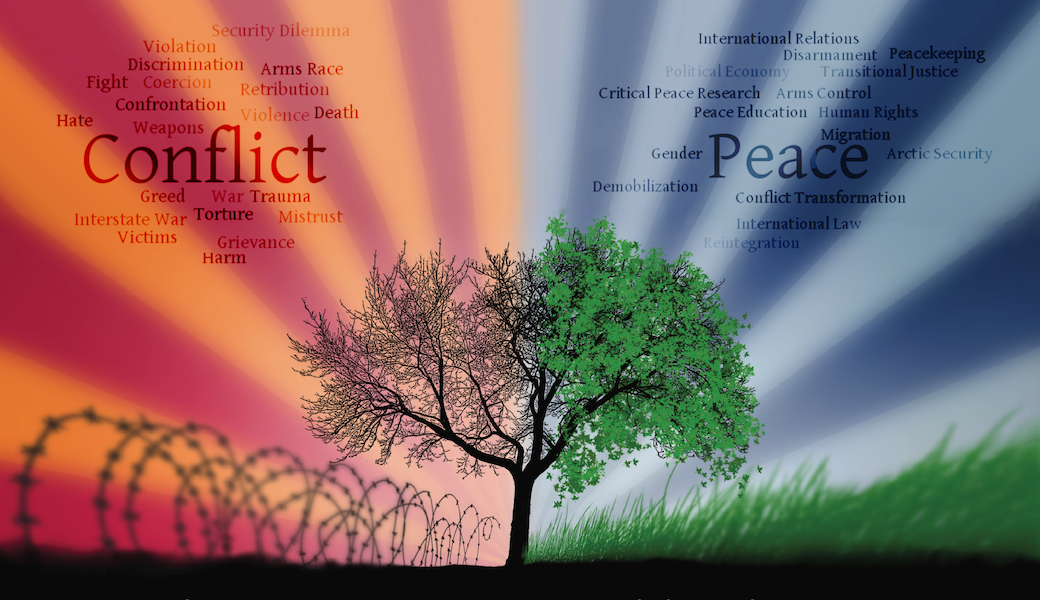
The Master's programme provides an in-depth understanding of the key issues shaping the field of peace and conflict studies. It offers critical and interdisciplinary insights into the nature, causes, and effects of conflict, as well as strategies for building peace and restoring confidence in institutions within conflict-affected societies.
What will you learn?
Practical execution
The curriculum constitutes a full-time study over two years, requiring approximately 1,500–1,800 work hours per year.
Learning activities include lectures, seminars, student presentations, peer reviews, individual supervision, excursions, and guest lectures.
The teaching and learning methods are problem-based, utilizing real-world cases and issues as teaching materials. These methods include lectures, seminars, and self-directed readings, all designed to enhance students' problem-solving and analytical skills, independent thinking, and critical evaluation. The programme's faculty includes renowned experts in their fields, both from the Centre and international institutions. The diverse teaching methods aim to strengthen students' problem-solving capabilities.
Each student will be assigned a thesis supervisor during the first year of study, primarily from one of two research groups affiliated with the Centre: the Peace Research Group and The Grey Zone. Supervision is provided through seminars and individual tutorials.
Studying abroad as part of an exchange programme will make you more competitive in the job market. It enhances learning outcomes, improves language skills, and provides unique adventures and international experience.
The Master’s degree programme in Peace and Conflict Transformation has bilateral exchange agreements with universities abroad, allowing students to take modules that can be approved as part of their degree. The programme facilitates outbound student exchange in the third semester, with some reservations regarding the availability of modules at the partner university.
Language of instruction
English
Programme structure
See the subjects you can take in this study programStudy plan
Read more about the campus:
TromsøAdmission requirements
Bachelor's degree (180 ECTS) or equivalent qualification in the social sciences, humanities, law, education, psychology or public health.
Grade requirement:
Applicants must have a minimum grade average comparable to a Norwegian C (2,5) in the ECTS scale.
English proficiency:
Applicants with education from non-Nordic countries must document English language proficiency. You will find more information about the English language requirements on our admissions pages.
Statement of Purpose:
Applicants must provide a Statement of Purpose (maximum of two pages). This Statement must state the applicant’s motivation for pursuing a Master's degree in this programme (i.e. relating prior academic achievements and professional experiences to the core concerns of the programme). There is no need for recommendation letters.
Admission capacity:
35 places.
Admission is competitive, based primarily on academic qualifications (educational background) and secondly on the quality of the Statement of Purpose.
You will find more information about international admission here.
What can you become?
The MPCT prepares students for challenging careers in sectors as diverse as security and diplomatic services, emergency and humanitarian assistance, international aid and donor agencies, and non-governmental organizations. In addition, MPCT offers transferrable competencies and skills for those who wish to pursue training in professions such as journalism and teaching. Ultimately, MPCT candidates may apply for admission to relevant PhD programmes.
Career opportunities
Access to further studies
On successful completion of the degree programme, students may be qualified for admission to a PhD programme in a number of academic areas at UiT the Arctic University of Norway or elsewhere.What are the students saying?
Outgoing exchange
Exchange studies abroad will make you more attractive on the job market. Studies abroad will increase your learning outcomes, improve your language skills, give you unique adventures and international experience.
The Master’s degree programme in Peace and Conflict Transformation (MPCT) has bilateral exchange agreements with universities abroad where the student may take modules that will subsequently be approved as part of the degree. In this degree programme, we make room for outbound student exchange in the 3rd semester. We make certain reservations concerning what modules the exchange university has to offer.
Studiesteder du kan utveksle til
Costs and support
Apply for student financial support from Lånekassen
You are responsible for covering your own travel and accommodation expenses for any required on-campus sessions and examinations.
Har du spørsmål?
hsl-instadm@uit.no +47 77660793 (09:00–15:00, lunch break 11:30–12:00)


Hvordan er det å være student i nord?
Følg @uitstudent på Instagram eller TikTok for å få et enda bedre innblikk i hvordan det er å studere på UiT. Her viser studentene fram sin studiehverdag, deler tips og nyttig informasjon, og du kan stille spørsmål om alt du måtte lure på.
Sjekk også @uitnorgesarktiske på Instagram eller TikTok for info om studier, jobbmuligheter og forskning.
