Notes of a border scholar turned amateur archivist
What is border art? And to what extent has it been present in Northern Norway and its neighbours Finland, Sweden and Russia over the past three and a half decades? A border scholar shares her thoughts.
My engagement with the triple borderland of Norway, Finland and Russia started in 2013 when I came to Kirkenes for the first time as a first-year doctoral candidate in border studies. During that visit, I met Hilde Methi, the main drive behind the Grensekunstarkiv - Border art archives. Since 2024 Kirkenes has been my home and since December 2025 I have been actively involved in preparation of the archive. Below I share some observations, discoveries, thoughts and emotions triggered by my contribution to the archive since that time.
Different perspectives coming together
I see Grensekunstarkiv as an element of a global effort to document life and more specifically artistic work at borderlands. In my writing, I often refer to this archive as the Barents Border Art Archive (BBAA) – with a regional denominator to distinguish it from a major border art archive that has been under preparation for several years by a team of Professor Anne-Laure Amilhat-Szary at the University Grenoble Alpes.
One of the challenging realities of the archive is the work of exclusion and inclusion, or in other words creation of the boundaries of the archive. Identifying artwork deemed valuable enough to be part of the archive is never a straightforward task.
There is a pressing need for more documentation in our border region that has been undergoing radical transformations with cultural and other interactions being halted in 2022 in the wake of Russia’s full-scale war against Ukraine. To have an even more comprehensive overview of art and other exchanges that existed in the recent past, we need multiple personal and institutional archives covering both border art and everyday borderland life.
Grensekunstarkiv is a personal archive, not a general one. This is both its limitation and its strength. It does not aim to cover all the ground, rather it preserves a record of a selection of border art enabled by the border porosity that existed at the shores of the Barents Sea in late 1980s-2022. It is a valuable contribution to the ongoing efforts to preserve border art around the world.
Finding the unexpected, feeling surprised
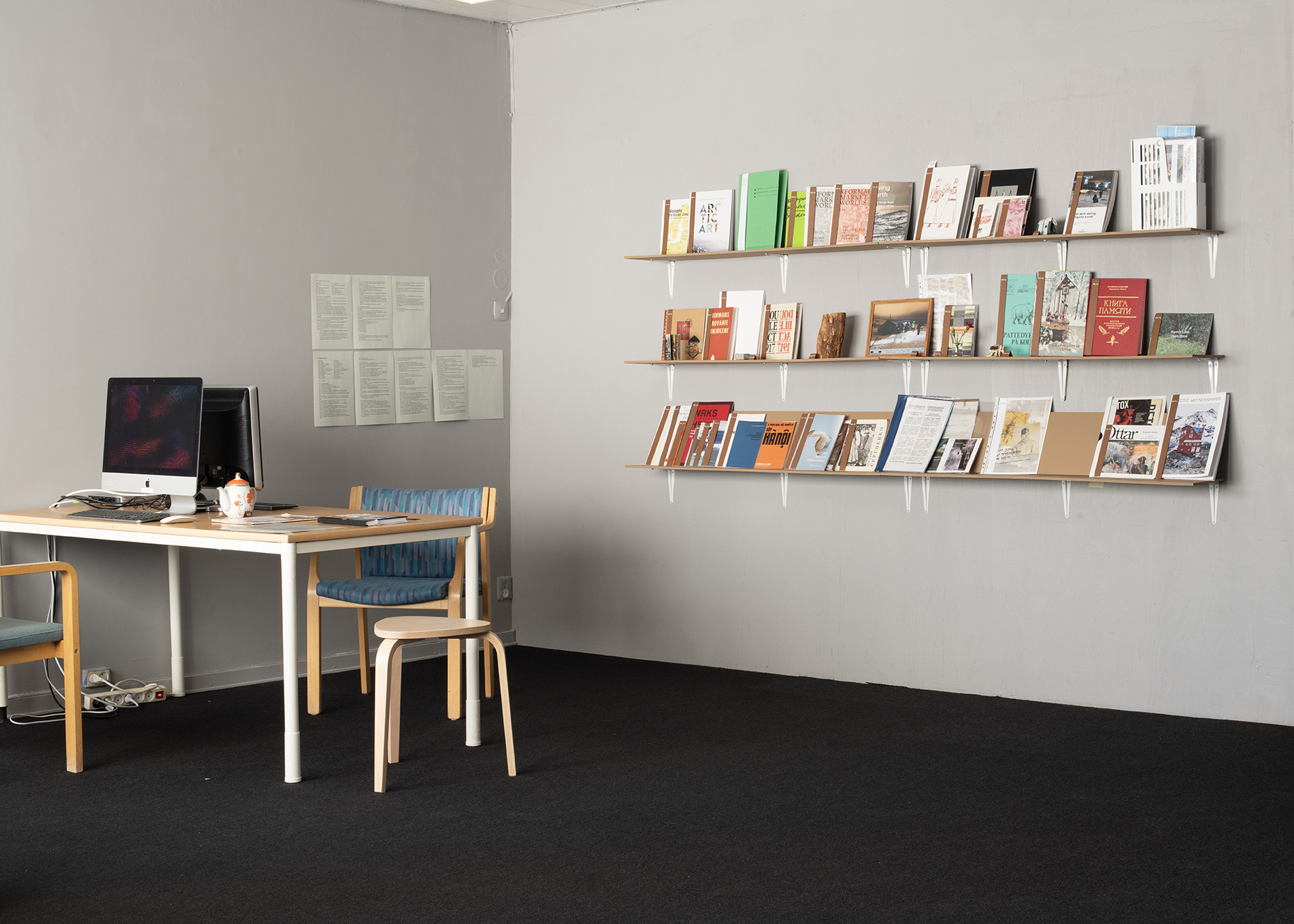
During the few months of my work with the archive, I had a profound feeling of unravelling some important historical layers of the borderland I call home. The first such revelation came when I was familiarising myself with materials about the Norwegian-Russian Art Centre (Norsk-Russisk Kunstsenter, NRKS) that operated in Kirkenes in 1992-1996.
It was our first working session at Hilde’s place, we were looking at the NRKS exhibition catalogues all featuring a large logo of Total, a Norwegian subsidiary of the French oil company that offered fellowships to Russian and Norwegian artists, making the NRKS art exchange possible. This was the first surprise: the sponsorship of NRKS had clear economic interests of multinational corporations embedded into it.
Then we explored the handmade catalogue of post-Leninism by Berit Overgaard, a textile artist who resided in Moscow from 1980 to 1984 as the wife of the Norwegian defence attaché posted in Moscow and Warsaw. Overgaard's interest in continuing the artistic exchange between Norwegian and Russian artists was an important impetus for the creation of NRKS. Yet, clearly the good will of local, regional, and national authorities on both sides as well as perestroika-triggered hopes of the general public also played a role. NRKS was intended to become a space for mutual inspiration and collaboration between Russian and Norwegian artists. Its opening was attended by Queen Sonja and King Harald V of Norway – a symbolic expression of the greatest possible support.
Another surprise came from the numerous similarities, echoes and allusions of artistic expression to the theme of previously fiercely sealed borders becoming open. One such echoing motif is a red thread central to the artwork “Fence” by Lise Bjørne Linnert exhibited in Severomosrk in 2013 and the red inscription outlining the Deatnu/Tana River basin in the artwork “Ellos Deatnu!” [Let the Tana River live!] by Outi Pieski (in collaboration with Jenni Laiti and Niillas Holmberg) in 2017. In Linnert’s piece, the red thread acts as a frame carefully wrapping the edge of a hole, turning it into a window into various social, economic and political issues. In Pieski’s work, the red text-line quotes a poem by Nillas Holmberg about Indigenous people’s relationship with the nature and similarly to Linnert’s work emphasises the encircled area – the Tana river basin that becomes the centrepiece of the lithography.
Another case of direct dialogue between an artwork and a poem is the tapestry by Berit Overgaard. This art piece creatively visualises a prominent example of what is often called ‘Soviet bard songs’ or ‘guitar poetry’ - a poem by Bulat Okudzhava “A visiting family has a picture taken in front of Pushkin’s statue” [“На фоне Пушкина снимается семейство”]. The poem zooms in to a tiny, yet significant moment of family life where a photo is taken next to the statue of Pushkin and not of Soviet leaders or ideologists, a small dissent in everyday life amid strict Brezhnev-era censorship that was waged not only against what was actually written but also against potential allusions and allegories.
Overgaard’s tapestry and Okudzhava’s poem resonate deeply with the title of the exhibition: "For history". This phrase, a mistranslation of a Russian expression "фото на память" [Eng. "photo for remembering"], borrowed from work by Kristin Tårnesvik, gives the visitor hope that personal memories can be safeguarded. It is indeed from the vantage point of personal life mediated via a combination of art forms and languages that we can better grasp the meaning of the past and the present.
Squaring the circle or the challenge of sorting and mapping the border art archive
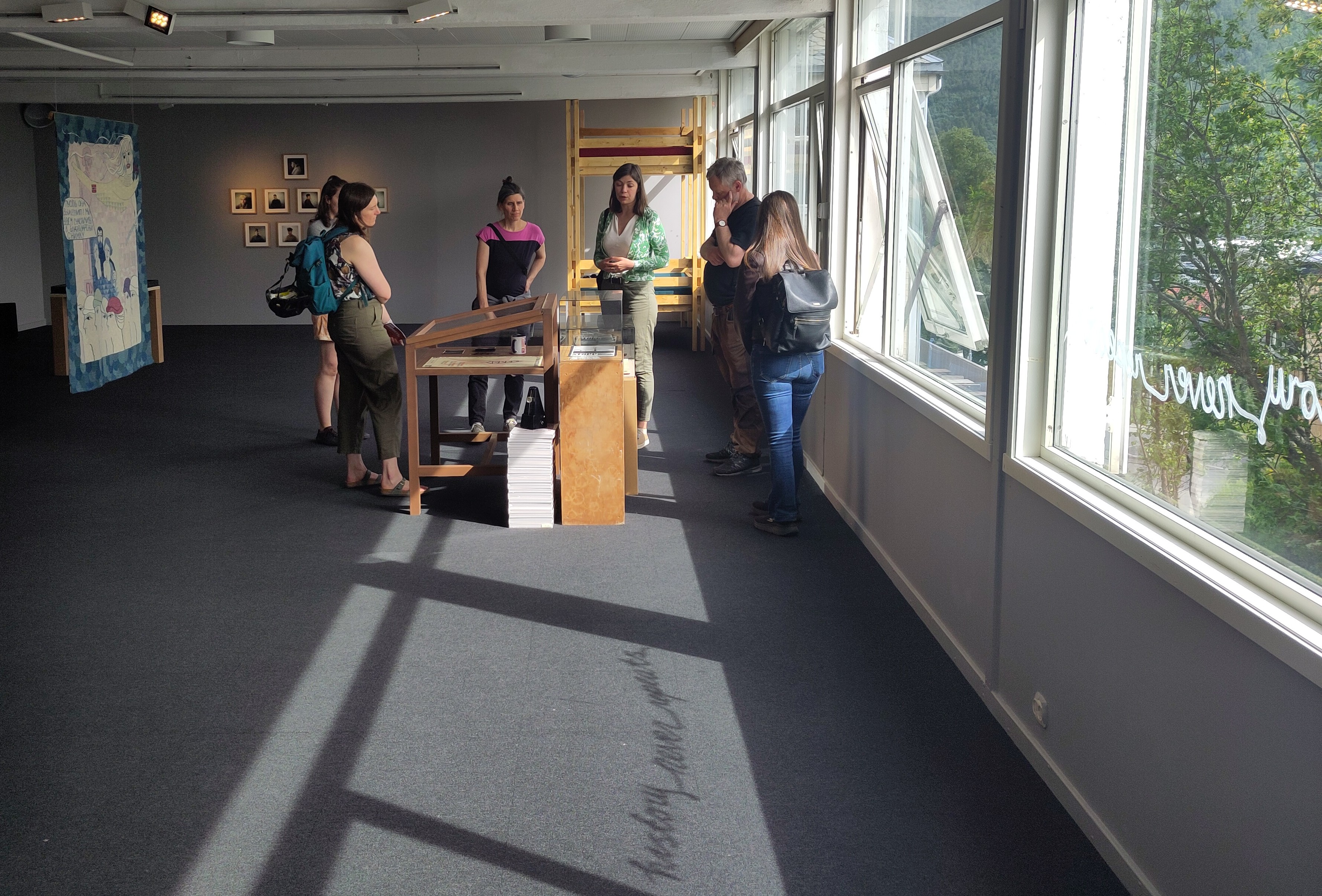
Archival work is not only surprising and rewarding, but also at times laborious and full of dilemmas. One has to identify not only the items – artists, artwork, exhibitions, art events, and so on – to be included but also the context in which they came about. This requires meticulous study of details – not a straightforward task, especially when we deal with items produced in non-digitalised or only partially digitalised times such as the late 1980s, 1990s and early 2000s.
As a geographer, my instinct is to visualise the art exchanges that brought about the artwork and artefacts that are exhibited today on the map. As a result of this work – conducted with the help of geography students from University of Liberec Hynek Müller and Tereza Havelková and in consultation with Hilde Methi – we have a rough mapping of traveling exhibitions, art residencies and geographically distributed art events. In principle, cartographic visualisation always encapsulates an exercise of simplification and selection. Thus, the map exhibited is a jumping off point for a conversation, not a full story.
Yet, even with the limited information we visualised, the map brings forward the fact that past art exchanges have covered a vast territory. While many projects functioned as a network with several key nodes, they were often striving to spread further and reach out further, both within the limits of the Barents region and beyond – bringing Barents border art to European capitals (Berlin, Copenhagen, Amsterdam) and bringing international artists from far away (e.g., Indonesia, Japan, Mexico) to the Barents region.
The Power of Untranslatable
It is not an accident that the title of the exhibition includes a mistranslation. Multilingualism and inevitably mistranslation have been an omnipresent feature of the Barents art exchange. Jury Lotman, the founder of the Tartu-Moscow school of semiotics, in his work suggests that “translation of the untranslatable” is the most fertile ground for developing cross-cultural understanding. Thus, encountering mistranslation and trying to make sense of it has been an integral part of the creative and artistic process that was operating in the cross-border multilingual Barents space.
In this context, I would like to bring one more language and one more concept into the discussion that may help engaging with the Grensekunstarkiv exhibition and the archive. This word is "souvenir". It comes from the French word "se souvenir", "to remember" and means something kept as a reminder. Today souvenir is a nearly universal word across languages, meaning an object representing a tangible, physical memory. Souvenirs lie at the intersection of travel, culture, art, symbolism, memory, time but also capitalism and consumerism. They have become associated with kitsch and futility.
The destiny of many artworks recorded in the Grensekunstarkiv and presented at this exhibition is still unknown - will they eventually become museum collections or not? Will they inspire new ideas and artwork in the future, or will they become "a souvenir for history", a token of remembrance increasingly seen as distant, aesthetically stimulating but irrelevant to present-day concerns? The final answer to this question depends on the personal discoveries and conclusions made at this exhibition. The Grensekunstarkiv itself has a more certain future. It is undoubtedly a unique learning resource, an act of “translation of the untranslatable” that sparks the imagination and helps in understanding our past and present.
You can learn more about border art at Tromsø Kunstforening this summer. Read more about the border art exhibition here: For History, Change Position

-
Arkeologi - master
Varighet: 2 År -
Peace and Conflict Transformation - master
Varighet: 2 År -
Geosciences - master
Varighet: 2 År -
Biology - master
Varighet: 2 År -
Technology and Safety - master
Varighet: 2 År -
Law of the Sea - master
Varighet: 3 Semestre -
Biologi - bachelor
Varighet: 3 År -
Nordisk - årsstudium
Varighet: 1 År -
Luftfartsfag - bachelor
Varighet: 3 År -
Pedagogikk - bachelor
Varighet: 3 År -
Arkeologi - bachelor
Varighet: 3 År -
Likestilling og kjønn - årsstudium
Varighet: 1 År -
Historie - bachelor
Varighet: 3 År -
Geovitenskap- bachelor
Varighet: 3 År -
Samfunnssikkerhet - bachelor
Varighet: 3 År -
Samfunnssikkerhet - master
Varighet: 2 År -
Kunst - bachelor
Varighet: 3 År -
Kunsthistorie - master
Varighet: 2 År -
Religionsvitenskap - årsstudium
Varighet: 1 År -
Romfysikk, sivilingeniør - master
Varighet: 5 År -
Sosialantropologi - bachelor
Varighet: 3 År -
Historie - master
Varighet: 2 År -
Anvendt fysikk og matematikk, sivilingeniør - master
Varighet: 5 År -
Barnevernsarbeid - master
Varighet: 2 År -
Forfatterstudium 2 - årsstudium
Varighet: 1 År -
Fine Art - master
Varighet: 2 År -
Barnevern - bachelor
Varighet: 3 År -
Arctic Nature Guide - one year programme
Varighet: 1 År -
Sosialt arbeid - bachelor
Varighet: 3 År -
Arktisk friluftsliv og naturguiding - bachelor
Varighet: 3 År -
Arktisk friluftsliv - årsstudium
Varighet: 1 År -
Grunnskolelærerutdanning for 1.-7. trinn - master
Varighet: 5 År -
Kunsthistorie - årsstudium
Varighet: 1 År -
Governance and Entrepreneurship in Northern and Indigenous Areas - master
Varighet: 4 År -
Vernepleie - bachelor
Varighet: 3 År -
Internasjonal beredskap - bachelor
Varighet: 3 År -
Barnevern - bachelor
Varighet: 3 År -
Vernepleie - bachelor
Varighet: 4 År -
Landskapsarkitektur - master
Varighet: 5 År -
Grunnskolelærerutdanning for 5.-10. trinn - master
Varighet: 5 År -
Kvensk og finsk - bachelor
Varighet: 3 År -
Nordisk språk og litteratur - bachelor
Varighet: 3 År -
Russisk og russlandsstudier - bachelor
Varighet: 3 År -
Ph.d.-program i naturvitenskap
Varighet: 3 År -
Russisk og russlandsstudier - master
Varighet: 2 År -
Environmental Law - master
Varighet: 2 År -
Nordisk språk og litteratur - master
Varighet: 2 År -
Kvensk og finsk - master
Varighet: 3 År -
Ph.d.-program i realfag
Varighet: 3 År -
Velferdsendring - erfaringsbasert master
Varighet: 4 År