About the study
Theoretical and Computational Chemistry is a great specialization for you if you want to use or develop chemical theory or computational chemistry software to work on research questions in chemistry and biological chemistry. In this specialization, the computer is your laboratory and you can learn about chemistry at a fundamental, quantum-mechanical level. This discipline is one of three specializations included in the Master's Degree Progam in Molecular Sciences.
What will you learn?
After completion of the programme, the candidate:
Knowledge
- has an overview of discipline-relevant scientific approaches to analyse and understand molecular properties and processes
- has thorough knowledge of theory and methods used in molecular sciences
- has advanced insight into international research and development within her or his discipline
- has acquired advanced knowledge and understanding needed to contribute to innovation and discovery within her or his discipline
Skills
- can independently use and analyse various sources of information to structure and formulate scientific arguments
- can independently produce and analyze data, products and results employing discipline-relevant scientific methods, instrumentation, and software
- can critically analyze and evaluate the quality of data and results
- can conduct scientific work and document results in accordance with applicable standards and norm for research ethics
- can carry out independent limited research under supervision
- can use state of the art software to model and analyse molecular structure, molecular properties, or chemical processes
- can develop and implement computational protocols to model chemical systems
- can predict or interpret the behaviour of chemical systems by making use of advanced computational infrastructure
General competence
- can critically read, cite, analyse and understand scientific literature
- can independently communicate scientific information clearly and precisely, bothwritten and oral forms
- can independently analyse and judge the reliability of information obtained from different sources and has a sound critical attitude towards knowledge from all sources
- can independently conduct research activities and communicate the research questions and results in both written and oral forms
- can carry out knowledge-based evaluations of general problems in science and communicate this to the public
- can accomplish research projects under guidance, e.g. under a PhD program in molecular sciences, chemistry or related areas
- can apply the obtained knowledge to independently solve new problems in natural sciences and to contribute to research and innovation
Program description
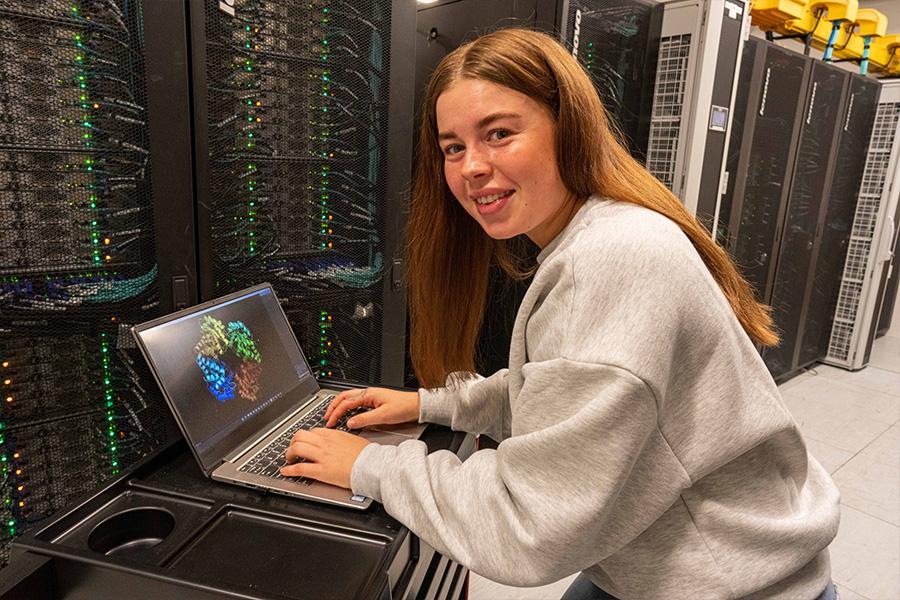
Theoretical and computational chemistry is indispensable in chemical research and is widely applied to assist in the design of new compounds, to understand chemical reactions and reactivity, to interpret experimental spectroscopic findings and to analyze biological data. This kind of chemistry can be used in situations where experimental work is difficult or expensive, for example if you want to screen a large number of candidate molecules for a drug to treat a disease. It can also be studied on its own to better understand fundamental topics in chemistry at a quantum-mechanical level, or it can be used in closer collaboration with laboratory work to guide, predict and interpret experiments in e.g. biochemistry and medicine. Much of computational chemistry takes place on high-performance computing systems and you will therefore get the opportunity to use modern supercomputers in this specialization.
Your master thesis project in Theoretical and Computational Chemistry could entail implementing a novel chemical scientific computing tool with C, C++, Fortran or Python. It could involve a more theoretical topic and be based in quantum chemistry, or it could be purely applied, using computational tools to study a research question. You can even combine aspects from all of these categories! Some possible topics are the simulation of chemical processes, biocatalysis and enzyme design, homogenous catalysts, complex molecular environments such as metalloenzymes and nanoparticles, development of methods for simulating established and novel spectroscopies, and the study of heavy and superheavy elements.
Through work on the master thesis and the other courses in this program, you will get a chance to consider chemistry at a fundamental and computational level. You can also become competent in scientific programming and scripting, working with high-performance computing systems, and using computational modeling as a research method. Many of these skills are useful in both an academic and a non-academic career.
Program Structure
Studyplan(s)
Studiesteder du kan utveksle til
What can you become?
Degree Name
Master of Science in Molecular SciencesHar du spørsmål?



You might also be interested in
Mathematical Sciences - master
Master in Mathematical sciences introduces you to mathematical research and the appliance of mathema...
Computational chemistry - master
Master computational chemistry at UiT. Model molecules, explore quantum science, join global researc...
Physics - master
Mobile phones, LED lights, radios, TVs and computers are advanced technical equipment based on physi...
Computer Science - master
Master in Computer science is highly practical and experimental, where the students learn to design,...
Følg @uitstudent på Instagram eller TikTok for å få et enda bedre innblikk i hvordan det er å studere på UiT. Her viser studentene fram sin studiehverdag, deler tips og nyttig informasjon, og du kan stille spørsmål om alt du måtte lure på.
Sjekk også @uitnorgesarktiske på Instagram eller TikTok for info om studier, jobbmuligheter og forskning.
