About the study
In a world perspective, Norway is unique with its immense number of lakes and rivers of great economic and recreational values. These abundant freshwater habitats also constitute excellent model systems both for exploring basic ecological research topics as well as for developing good management strategies. With a master’s degree in Freshwater Ecology, you will be ready to take on jobs within nature management, higher education and consultancy, or continue with research within freshwater ecology and related subjects.
This study programme requires compulsory attendance to the introductory meeting. See this web page for more information.
What will you learn?
Program description
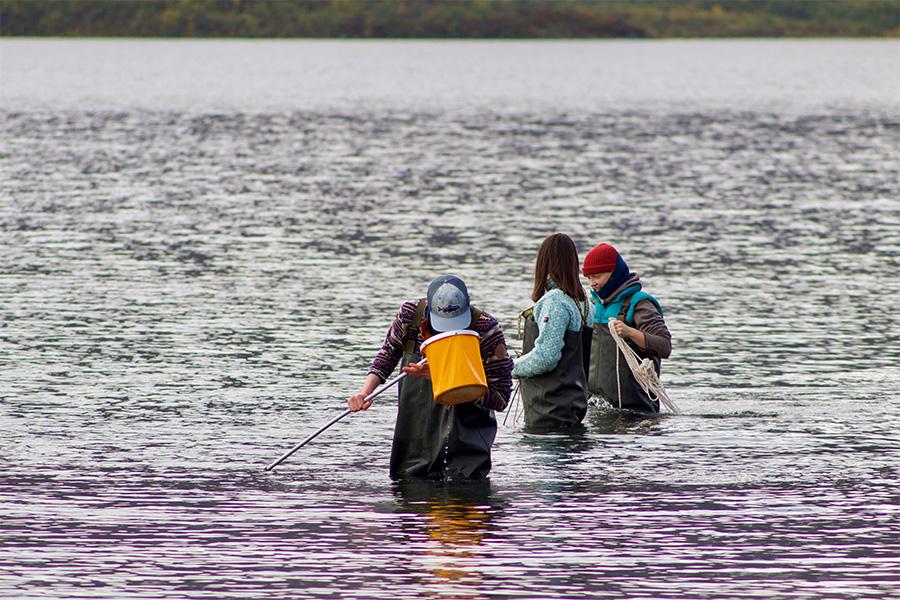
The freshwater ecology specialization focuses on research in lakes, rivers, and coastal areas, studying fish (especially salmonids), invertebrates, and parasites. MSc projects explore both fundamental ecology and applied topics like nature and resource management. Key themes include population and community ecology, predation, competition, parasitism, food webs, invasive species, migration, life history, catchments to coasts, and the impacts of climate change.
Students will be an integral part of the Freshwater Ecology Research Group and are expected to participate actively.
Program Structure
Studyplan(s)
Language of instruction
The language of instruction and all syllabus material is English.
Teaching and assessment
Several teaching and assessment methods are employed, including lectures, seminars, laboratory work, computer lab and field courses. These will vary from course to course.
Course examinations may be oral or written examinations, assessments of project work/ lab reports/field reports, often in combination.
Supervision of the project work that leads to the writing of the Master`s thesis will be given by faculty staff, sometimes in co-operation with an external supervisor.
Outgoing exchange
Students can undertake periods of studying at The University Centre at Svalbard (UNIS).
International exchange during an entire semester is not possible in the first year of studies due to obligatory courses.
Stays abroad can take place as part of a master project in the third and fourth semester. Please consult the program study advisor for more information.
Studiesteder du kan utveksle til
What can you become?
Job prospectives
The Master’s degree in Biology will allow you to qualify for different career paths and prepare you to step into a professional role or to apply for a PhD.
A Master of Science degree in Biology will prepare you for a wide range of jobs, in both public and private sectors, including research, resource and nature management, administration, consulting and the teaching profession.
The master thesis can play an important role to establish your domain of expertise and to showcase acquired technical and soft skills. Also, it can be very important in building scientific and professional network, that will be a support in your future job search.
Har du spørsmål?



Følg @uitstudent på Instagram eller TikTok for å få et enda bedre innblikk i hvordan det er å studere på UiT. Her viser studentene fram sin studiehverdag, deler tips og nyttig informasjon, og du kan stille spørsmål om alt du måtte lure på.
Sjekk også @uitnorgesarktiske på Instagram eller TikTok for info om studier, jobbmuligheter og forskning.
