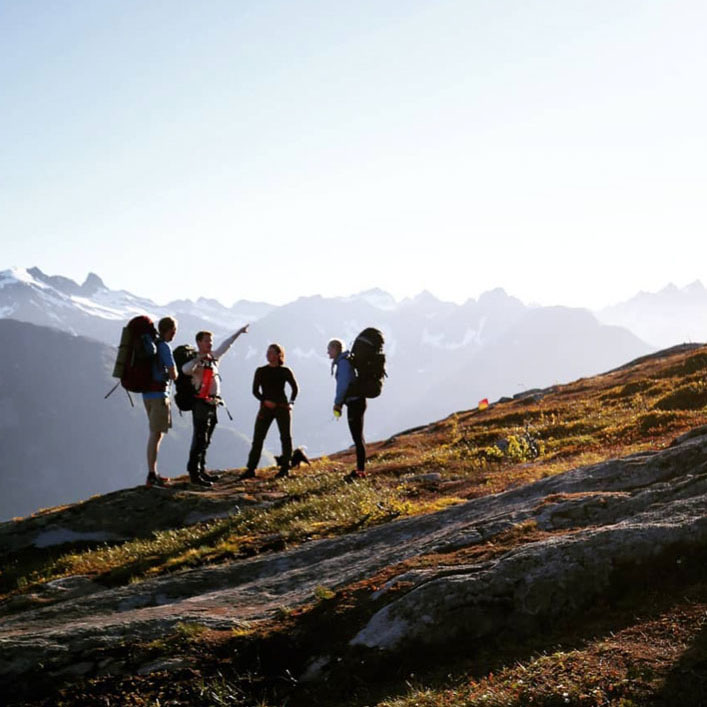

– The most rewarding aspect of the programme has been its diversity
Helena Wuehrer
Les intervjuet
The Joint Nordic Master Programme in Environmental Law (NOMPEL) aims to provide first class learning for students who want to gain expertise in international and EU environmental law, including those who want to subsequently pursue a PhD. The objective is to provide advanced knowledge in environmental law and insight into how crucial environmental issues are regulated internationally, within the EU, and in the Nordic states. Students will acquire specialist knowledge and legal expertise on the management of natural resources, the protection of biodiversity, climate change, and the energy transition.
Classes are taught by a range of international scholars through a series of lectures and seminars. There is a strong research approach to the programme, whereby students are expected to carry out their own investigations before class and will complete an individually written Master's thesis under expert supervision.
NOMPEL hereby gives students the unique opportunity to study in three Nordic countries at universities that each have specialist competence in environmental law, and to experience their different cultures and social environments.
The objective of NOMPEL is to educate and examine master students with competencies in three complementary domains, as stipulated in the Swedish Higher Education Ordinance (1993:100), annex 2:
Knowledge and Understanding: Candidates can:
Competence and Skills: Candidates have the ability to:
Judgement and Approach: Candidates can:
It is clear, that environmental law is extensive and growing internationally, within the EU and nationally. Therefore, expertise in this complex legal field is requested, not least in connection with a sustainable management of natural resources and the protection of biodiversity and in the field of climate and energy law. Environmental law experts are needed at ministries, at state and municipal authorities, in courts, within the EU Commission, and the UN Environmental Program, as well as in companies, law firms, environmental organisations, etc. A degree from the NOMPEL program should then be very competitive.
This degree is very valuable if you apply for PhD studies in environmental law. Environmental law research is very active, not least in the Nordic countries. Universities require competent researchers and professors in the discipline. Having a degree in environmental law is also an important merit if you apply for another Master programme with environmental focus.
Problem solving and active student participation are the essential components of NOMPEL. Teaching methods include, inter alia, analyses of court cases and constructed hypothetical cases, and discussions related to student presentations.
NOMPEL teaching staff encourages critical thinking and independent study. Students are offered a wide range of teaching and learning activities as appropriate to the aims of the individual courses. These include (a) lectures followed by plenary discussion - sessions supported by written texts and presentations; (b) seminars organised as participative lectures or with student presentations; and (c) workshops and smaller seminar groups exploring the themes of the preceding presentations or addressing pre-given tasks, texts and questions. The writing of individual assignments represents an integrated part of the learning approach. Students are encouraged to use study groups as a resource for learning and debate. The use of learning approaches varies within individual modules and university traditions, but all participants are encouraged to develop a common course identity. Students are responsible for creating study groups, to consolidate shared interests and to pursue a more in-depth study of an issue.
Continuity and progression are assured by means of the design of the curriculum. The first semester lays the foundations and provides the basis for understanding approaches, perspectives and tools in international and EU environmental law and the law on energy transition. The second and third semester provide in-depth studies of (i) natural resources management and biodiversity law and (ii) climate change and energy law. The fourth semester enables students to consolidate and expand their understanding of the subjects covered in the Programme, by pursuing an independent research project linked to the subjects taught in the programme.
The institution responsible for each course determines the rules and processes concerning the assessment and grading of that course.
The student must have obtained 75 ECTS in NOMPEL courses in order to progress to the fourth semester.
This study programme requires compulsory attendance to the introductory meeting. See this web page for more information.
English
A Bachelor of Law corresponding to at least three years of full-time study (180 ECTS credits). Alternatively, a university degree of at least 180 ECTS credits, comprising or in combination with at least 90 ECTS credits in legal studies.
Since this is a joint Master Programme, the degree must be approved by all participating universities according to the rules in each NOMPEL country.
Language Requirements
Knowledge of English equivalent to the Swedish upper secondary course English 6 is required.
This requirement can be met either by achieving the required score on an internationally recognised test, or by previous upper secondary or university studies in some countries. Detailed instructions on how to provide evidence of your English proficiency are available at universityadmissions.se.
Admission procedure
The Cooperation Agreement stipulates the admission procedure.
Selection:
Students are selected based on
Students will be admitted to the Programme at Uppsala University, which administers the admissions, in accordance with Swedish legislation and procedures adopted by Uppsala University, and the qualification requirements specified in the Programme Educational Plan. Uppsala University is responsible for managing any complaints submitted about decisions concerning the admission to the Programme.
For information on how to apply, what documents you need to submit, and the application fee, check the Uppsala University application guide. Besides the general supporting documents, you also need to submit a statement of purpose (1 page). The statement of purpose should include information on previous education, work and other experience.
In accordance with local capacity and regulations, the number of students to be admitted each year to the Programme must be decided annually by the Parties, after consultation with the Steering Committee. The aim is to admit 25 students each year.
Students admitted to the Programme by Uppsala University are also registered at the University of Eastern Finland and at UiT The Arctic University of Norway, to gain study rights as a degree student and be able to access student services.
Student fees
Students from outside of EU and EEA countries and Switzerland will be subject to tuition and application fees, when studying at Uppsala University and the University of Eastern Finland. Information about application and tuition fees for the first semesterat Uppsala University can be found on their website. Tuition fees for the second semester set by the University of Eastern Finland, can be found on their website.
All students are required to pay a semester fee to the Arctic Student Welfare Organisation for studies administered by UiT The Artic University of Norway. All Master’s degree students at the University of Eastern Finland are required to join the Student Union and must pay the student union membership fee for the semester they spend at that university. All students are furthermore required to pay a healthcare fee for the semester they spend at the University of Eastern Finland.
Uppsala University, the University of Eastern Finland and UiT The Arctic University of Norway determine the level of fees, in accordance with national and institutional regulations and procedures. The fees shall be collected by the Party in question, during the semester the student is studying at that University.
Students will be financially responsible for:


Følg @uitstudent på Instagram eller TikTok for å få et enda bedre innblikk i hvordan det er å studere på UiT. Her viser studentene fram sin studiehverdag, deler tips og nyttig informasjon, og du kan stille spørsmål om alt du måtte lure på.
Sjekk også @uitnorgesarktiske på Instagram eller TikTok for info om studier, jobbmuligheter og forskning.