Pelagia Tsalampouni

Facts
Before beginning the Joint Nordic Master Programme in Environmental Law (NOMPEL), Pelagia Tsalampouni had already built a diverse legal career in Greece. She worked across a wide range of fields, including corporate law, immigration law, data protection, and technology-related legal issues. While the variety gave her valuable professional experience, it also prompted her to look beyond traditional legal practice toward questions with broader societal and global significance. "That variety taught me just how expansive the role of a lawyer can really be", she explains. "It pulled me increasingly toward areas where law intersects with bigger, global challenges.”
Already as an undergraduate student at Aristotle University of Thessaloniki, where she first completed a law degree followed by an LL.M. in International and European Studies, Pelgia found herself consistently drawn to legal issues that crossed national borders, explaining that she was "always interested in anything that required navigating between different legal systems and ways of thinking."
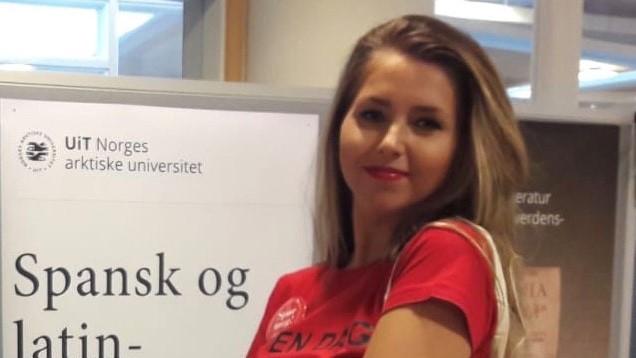
The Joint Nordic Master Programme in Environmental Law proved to be a natural fit. Combining international perspectives with one of today's most pressing global challenges, the programme offered exactly the interdisciplinary and cross-border approach she was looking for. Having now completed the degree, Pelagia reflects on her journey through three Nordic universities, spending her first semester at Uppsala University in Sweden, her second at the University of Eastern Finland, and her final year at UiT The Arctic University of Norway in the city of Tromsø.
What motivated you to apply for NOMPEL, and what initially sparked your interest in environmental law?
My interest in environmental law actually traces back to my LLM thesis, which focused on corporate liability for transboundary environmental damage. The deeper I dug into that topic, the more I realised how genuinely complex, and genuinely fascinating, environmental issues are from a legal standpoint.
What hooked me was that environmental law isn’t just rules on a page, it’s a constant search for solutions to problems that touch everyone, regardless of borders. NOMPEL felt like the natural next step, a chance to dive into this field properly while also immersing myself in different legal systems and cultures.
The programme takes place across different Nordic countries. How has studying in these different academic and cultural settings influenced your experience?
Honestly, this has been one of the most transformative parts of the entire programme. Moving between countries and universities forces you to see that the same environmental problem can look completely different depending on where you’re standing — different legal traditions, different priorities, different cultural assumptions baked into the law itself.
But beyond the academics, what really stayed with me is the people. Studying together, relocating together, figuring out new cities and new systems together…somewhere along the way, my classmates stopped being just classmates. We became a family. We built our own little community, one that didn’t depend on any single country or university, and the bond that came out of that is honestly unbreakable. No matter where any of us end up after this, I know that connection isn’t going anywhere.
How would you describe the courses and teaching approaches within the programme? Are there any particular topics, seminars, or learning experiences that have been especially interesting?
The courses are far from passive lecture-and-listen sessions — there’s real discussion, real debate, and that pushes you to think critically rather than just absorb information.
I’ve especially loved diving into climate law, corporate responsibility, and the role of law in the energy transition. It’s been genuinely exciting to watch these topics intersect with areas I already knew well, like business and international law. It was almost like discovering a hidden layer underneath subjects I thought I already understood.
What has your experience been like as a student in Tromsø, both inside and outside the classroom?
Tromsø has been unlike anything I’ve experienced before. Studying environmental law against the backdrop of the Arctic landscape makes every topic feel immediate and real. It’s hard to discuss climate impacts in the abstract when you’re literally standing in the middle of the environment being discussed.
Outside the classroom, the lifestyle here is a world away from Greece, and living this close to nature has reshaped how I think about my surroundings entirely. The international community in Tromsø has been another highlight. There’s something special about building a life, even temporarily, alongside people from so many different corners of the world.
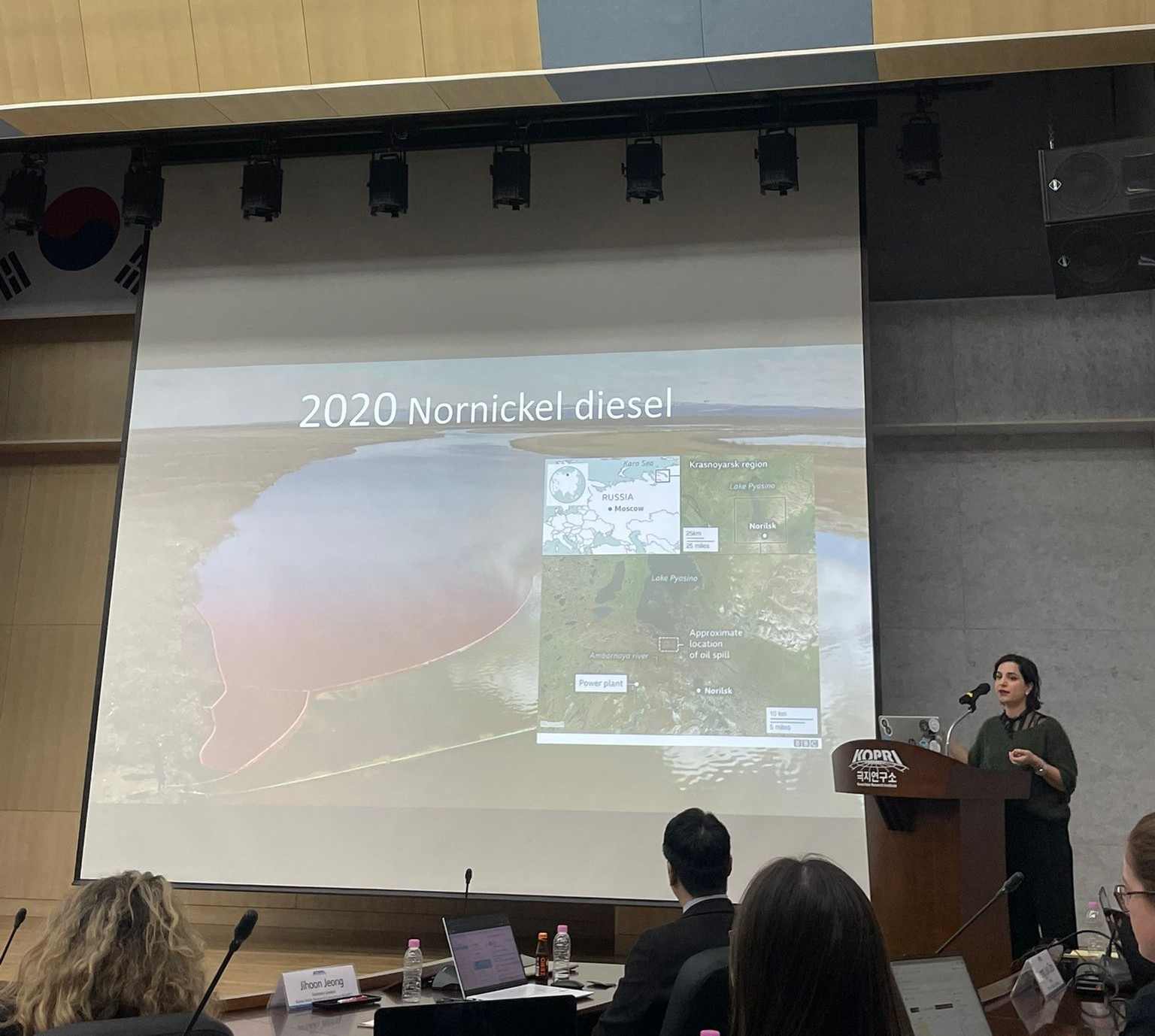
I’m also incredibly thankful to the university for the opportunities it gave me to step outside the classroom entirely. Being able to participate in international conferences and dive deeper into Arctic governance topics was a privilege I didn’t take for granted — it took my understanding of the field far beyond anything a textbook could offer. These opportunities took me as far as Seattle and Vancouver, and even all the way to South Korea, each trip opening my eyes to how Arctic governance is discussed and approached on a truly global stage. Looking back, these experiences have been some of the most enriching parts of my entire time in the programme.
Looking ahead, what kind of career path do you hope to pursue after completing the programme, and how has your experience in NOMPEL helped shape those ambitions?
I want to keep building a career at the intersection of environmental law, energy, and corporate responsibility. I was already curious about how businesses and legal systems interact before NOMPEL, but the programme has sharpened that interest and given it an environmental lens I didn’t have before.
If anything, NOMPEL has confirmed something I already suspected. I want to work somewhere law isn’t just theory, but a tool that actually moves the needle on real-world problems.
What advice would you offer to students who are thinking about applying to the NOMPEL programme?
Apply — without hesitation — if environmental issues genuinely interest you and you’re craving something different. This programme gives you far more than academic knowledge. You gain a second family, new ways of thinking, and a version of yourself that’s been tested and stretched by unfamiliar places and people.
My biggest piece of advice is to come in with an open mind. Be ready to learn not just from the curriculum, but from everyone you meet along the way — because some of the best lessons in NOMPEL don’t come from a syllabus at all.