Regulation of Epithelial-to-Mesenchymal Transition (EMT) by Selective Autophagy – (REMTSA)
REMTSA studies how selective autophagy controls the cellular changes that allow breast cancer cells to spread. By investigating EMT, MET and their molecular regulators, the project seeks to uncover new biomarkers and therapeutic strategies for metastatic breast cancer.
Metastasis, invasiveness, and treatment resistance remain major challenges in breast cancer therapy. These aggressive characteristics are strongly associated with breast cancer stem-like cells, which can undergo epithelial-to-mesenchymal transition (EMT). During EMT, epithelial cells lose their polarity and cell–cell contacts and acquire a more motile and invasive phenotype. This transition enables cancer cells to migrate from the primary tumor and invade surrounding tissues.
EMT is a reversible process. Through the reverse transition, known as mesenchymal-to-epithelial transition (MET), disseminated cancer cells can regain epithelial characteristics and establish secondary tumors in distant organs. Consequently, targeting the mechanisms that regulate EMT and MET represents a promising therapeutic strategy. However, this approach has not yet been fully realized, partly because the molecular mechanisms governing these transitions remain incompletely understood. In addition, many of the factors involved in EMT induction and MET development have not yet been comprehensively identified or functionally validated.
EMT shares important features with the processes through which normal stem cells acquire and maintain stemness. Selective autophagy is essential for stem-cell development and function, but its role in EMT remains poorly understood. It is also unclear whether selective autophagy contributes to the reversal of EMT through MET, a process that is critical for the establishment of metastatic tumors.
REMTSA addresses these knowledge gaps by investigating the relationship between selective autophagy and EMT in breast cancer. The project will use a holistic and interdisciplinary strategy to identify the molecular mechanisms that control cancer-cell plasticity, metastasis, and treatment response.
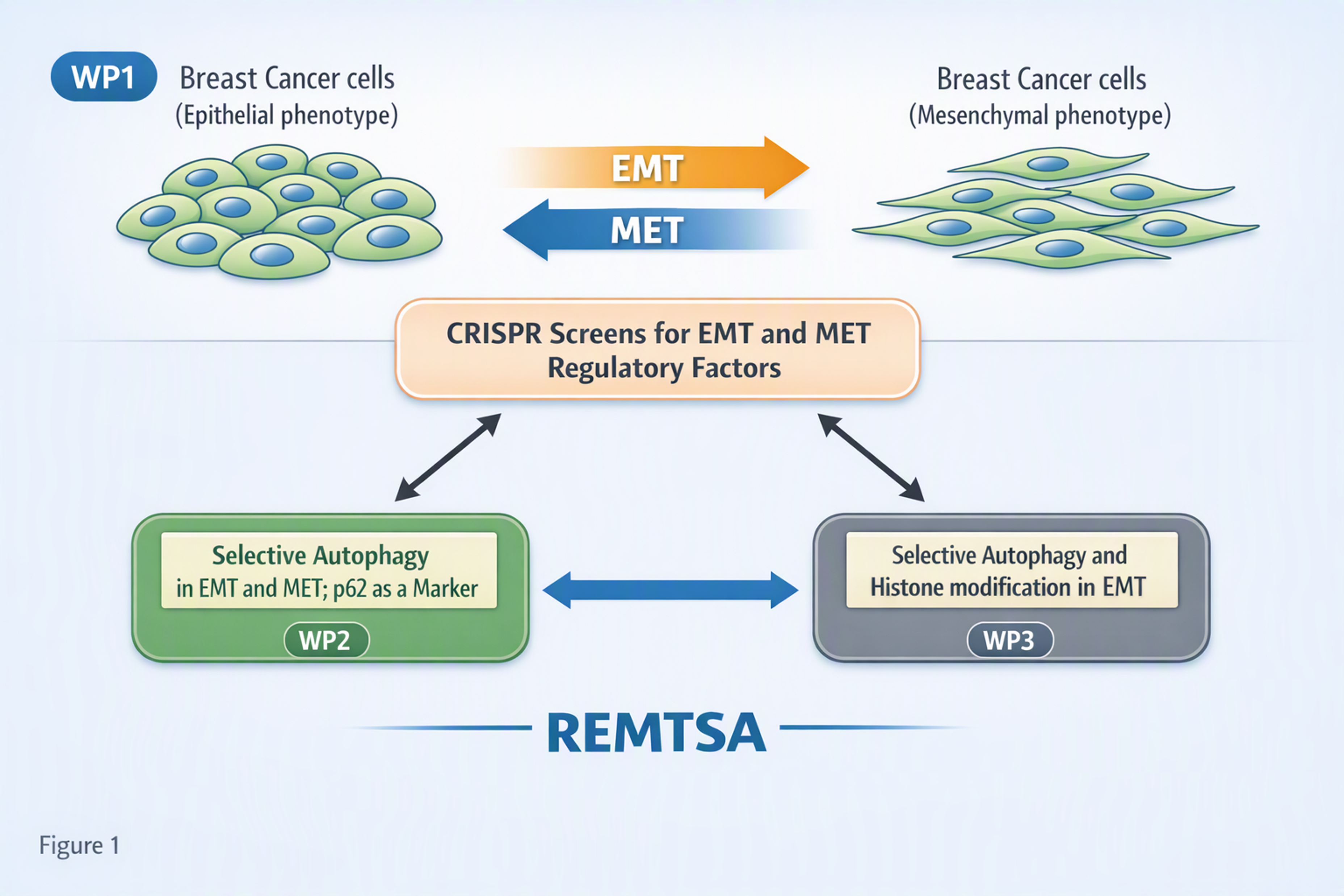
Figure 1: Project overview
REMTSA will employ unbiased, whole-genome CRISPR/Cas9 screens to identify regulatory factors involved in EMT and MET. These screens will also systematically define the contribution of selective-autophagy regulators to EMT and MET (WP1).
Using breast epithelial and breast cancer cell models, WP2 will determine whether and how selective autophagy regulates EMT and MET. This work will also investigate whether the selective-autophagy receptor p62/SQSTM1 can serve as a prognostic marker for breast cancer metastasis.
Finally, WP3 will examine the interplay between selective autophagy, histone modification, and EHMT2 regulation in the control of EMT. By integrating molecular biology, structural biology, breast cancer genomics, and advanced optical nanoscopy in ex vivo breast-tissue models, REMTSA aims to define how selective autophagy and EMT are interconnected.
The project may reveal new biomarkers and therapeutic targets for preventing breast cancer invasion, metastasis, and treatment resistance.
[Loading...]