Revolutionizing DNA analysis
Her dream was to become a police officer, but then Stine Hansen discovered how to catch bad guys using DNA. Now her DNA analysis method is among the best in the world.
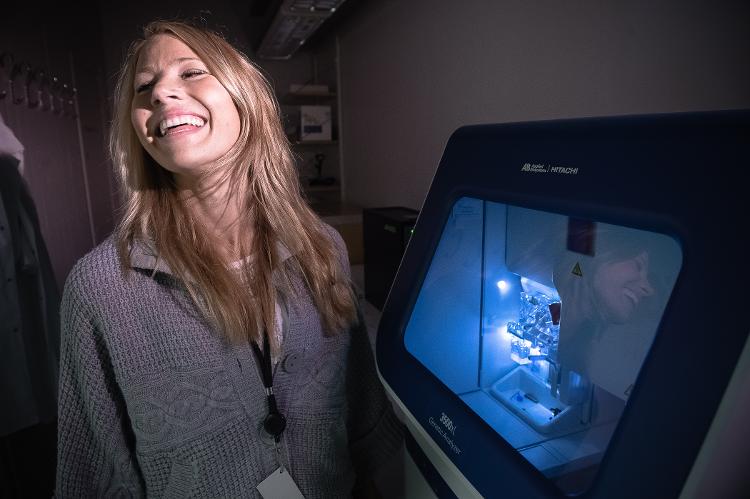 |
| Stine’s DNA analysis method can be compared to a book. "Previously we were able to find most of the sentences in the book, but with Stine’s method, we can find every single letter," says senior advisor Toril Fagerheim.Photo: Lars Åke Andersen |
“If a criminal leaves behind any DNA, I should be able to identify him,” says Stine Hansen, who has a master’s of science degree.
The Tromsø native is Norway’s answer to the CSI agents who solve murder mysteries on our TV screens at night.
“Real life doesn’t resemble TV shows that much, we don’t really go around with guns on our hips,” says Hansen, who instead has a master’s degree in forensic genetics as her best weapon. And it's a weapon that she can use to wield a powerful blow.
Hansen is actually the only person who has done a master’s degree in forensic genetics in Norway. Through her education at the Faculty of Health Sciences at the University of Tromsø, she has gained expertise in profiling DNA from crime scenes. And her master’s thesis in forensic genetics has taken the tracing of DNA to a whole new level.
“Stine’s DNA analysis method can be compared to a book. Previously we were able to find most of the sentences in the book, but with Stine’s method, we can find every single letter. It’s much more precise,” explains Toril Fagerheim, senior advisor at the Centre of Forensic Genetics at UiT.
Little genetic difference
DNA can be found in almost all the body’s cells, and carries genetic information that is passed on from one generation to the next. With the exception of identical twins, every individual’s DNA has a unique composition. Half of our DNA is inherited from our mother, half from our father.
“Ninety-nine point seven per cent of human genes are shared between all individuals. The remaining 0.3% is where the differences are, what makes us individuals. These differences are what we use in forensic genetics,” Hansen says.
She explains that making a DNA profile using today’ methods, it is necessary to isolate 17 genetic markers from the DNA sample. Comparing these 17 markers enables scientists and researchers to differentiate people.
Stine Hansen’s master’s degree, however, focuses on an alternative method that only requires five markers. The method is faster and more efficient, and gives information that we could only dream about in the past.
|
What is DNA? |
| Deoxyribonucleic Acid is the chemical term forthe hereditary material known as DNA.DNA in the cell’s nucleus contains all of theinformation about an organism’s developmentand appearance.DNA molecules are long twisted threads composedof four different molecules. The molecules are puttogether in a “recipe” that determines the organism’smake up. A single strand of DNA from a human isabout two meters long.(Regjeringen.no, dammskolen.no) |
Need for DNA analysis
With her five years of education, Hansen feels ready to assist the police in fighting crime. In her new job as the department engineer at the Forensic Medicine Centre at UiT, she has all of the equipment she needs.
The Forensic Medicine Centre’s vision is to have the capacity to analyse 20-25 per cent of the country’s DNA tests. That way the police will get results from important DNA samples faster, as there currently tends to be a delay in getting results. Recently The Forensic Medicine Centre received grant money and can now start their work.
“There is no doubt that we need a forensics laboratory in Tromsø. The only place that has done forensic DNA analysis in Norway is the Division of Forensic Medicine and Drug Abuse Research in Oslo, which is a part of the Norwegian Institute of Public Health,” says Thomas Berg, a senior adviser at UiT’s Centre of Forensic Genetics.
“Sometimes, during complicated criminal cases, there is a need for a ‘second opinion’, a new, separate and independent evaluation. This needs to come from a different lab, which emphasizes the need for two DNA labs in Norway, as a part of the effort to tighten the law,” he adds.
|
Where is DNA? |
| DNA is found in all of our nucleated cells, meaning allcells in the body’s organs, skin, mucus membranes,and certain quantities in all bodily fluids. That makes itpossible to analyse DNA from traces of blood and sperm,or traces of saliva (on cigarette butts, bottles, masks…)and traces of skin (on tools and surfaces). (Regjeringen.no) |
The centre, which is co-located with the Faculty of Health Sciences at UiT, also wants to be able to conduct research and to teach.
“Denmark has already started to use the method that I learned. The 17-point method we use here in Norway was introduced in the early 1990’s, so I hope that I can contribute with the expertise that I have,” Hansen says.
She points out that the current technique used in Norwegian DNA analysis, isn’t bad.
“The current method is accurate, but the new method provides more detailed information. In addition, it is faster and more efficient. It is important that Norway keeps up with the latest research developments,” she says.
| DNA and Crime Fighting |
| With the exception of identical twins, each person’s DNA is unique to that person. The genetic material also provides information about a person’s biological origin. This is why it is can be used in identification. Under Norwegian law, biological material for DNA testing can be taken from any individual who with just cause is suspected of a criminal offense that may result in imprisonment (Law for Criminal Procedures). The same applies to anyone who is convicted of these kinds of offenses. A national DNA database has been established for use in fighting crime, where individual DNA profiles can be registered. Biological material can also be taken in the context of the Immigration Act and the Children’s Act (for paternity cases). (Sources: Straffeprosessloven, utlendingsloven, barneloven, farskap.no, Helsefak) |