Conference on Small scale fisheries successfully realized!
For two days academics and staff discussed different challenges related to Small-scale fisheries. On the outset the Voluntary guidelines for small-scale Fisheries development was presented by Nicole Franz from the FAO

(http://www.fao.org/3/a-i4356e.pdf). The guidelines are some sort of a "norm-set" for fisheries in general and the small-scale sector specifically. These are covering most of the field of fisheries, from boat operations to land facilities, marketing and conumption. The guidelines are closely connected to FAO Fisheries Code of Conduct for responsible fisheries, accepted in 1995 (http://www.fao.org/docrep/005/v9878e/v9878e00.htm)
These have been accepted by a majority of the World's nations, and Norway was one of the first. Franz presentation was followed and commented upon by Prof. Ratana Chuenpagdee from TBTI (Too big to Ignore http://toobigtoignore.net/ ) and Prof. Svein Jentoft from UiT Arctic university of Norway. Prof Chuenpagdee´s presentation described well the a vast network of people in fishing operations, public employes and scientific staff. Jentoft commented the Norwegian fisheries example in the light of the Guidelines for SSF, and said that some of that policy may be out of line with these. In all one calculates that as many as up to 500 million people are employed in direct operations at sea or land, and indirectly with marketing and value chain. Many people throughout the world experience hardships and therefore the guidelines are extremely important, although voluntary.

A long list of speakers related to the guidelines in different forms. We had presentations from a variety of academic staff - marine biologists and ecologists, food chemists, one philosopher, statistcians, geographers and economists. Mrs. Brit Fisknes, a long time NORAD employee, now retired brought forward her experiences after decades of Fisheries development work.
Program
1 november (12:00 – 17:00), Moderator: Jens Revold, University of Tromsø
12:00 – 12:45 Lunch
12:45 – 13:00 Welcome
13:00 – 13:30 Nicole Franz (The Food and Agricultural Organization of the United Nations): FAO Guidelines for Small-Scale Fisheries
13:30 – 14:00 Svein Jentoft (The University of Tromsø): The Norwegian example; how relevant for the global south?
14:00 – 14:30 Coffee Break
14:30 – 15:00 Ratana Chuuenpagdee (Too Big To Ignore): Research and Governance for Small-Scale Fisheries: Global visions
15:00 – 15:30 Matthias Kaiser (The University of Bergen): Thinking horizontally!
15:30 – 16:00 Edel Elvevoll (The University of Tromsø): Knowledge-based Development cooperation for global food production
16:00 – 16:30 Elvar Hallfredsson (The Institute of Marine Research): Data collection in data poor areas
16:30 – 17:00 Elizabeth Selig (The Norwegian Institute for Water Research): Using lessons learned to catalyze management effectiveness in small-scale fisheries
17:00 Sum-up, day 1
19:00 FFF Dinner Restaurant Skirri, Kystens Hus
2 november (09:00-15:00) – Case studies, Moderator: Åsmund Bjordal, Institute of Marine Research
09:00 – 09:30 Trond Almendingen (The Directorate of Fisheries): Sri Lanka
09:30 – 10:00 Even Moland (The Institute of Marine Research): Sudan
10:00 – 10:30 Coffee Break
10:30 – 11:00 Ragnhild Overå (The University of Bergen): From canoe to table: A value-chain perspective on small-scale fisheries and food security
11:00 – 11:30 Kari Strande (The Ministry of Local Government and Modernisation): Possibilities with the Norwegian Peace Corps
11:30 – 12:30 Lunch
12:30 – 13:00 Brit Fisknes (The Norwegian Agency for Development Cooperation): Experiences
13:00 – 13:30 Evert Flier (Norwegian Mapping Authority): Knowledge on the ocean soil in support of the UN 2030 Sustainable Development Goal 14
13:30 – 14:00 Sylvia Frantzen (National Institute for Nutrition and Seafood Research): Food safety; Documentation and surveillance of contaminants in seafood
14:30 – 15:00 Discussions and sum-up

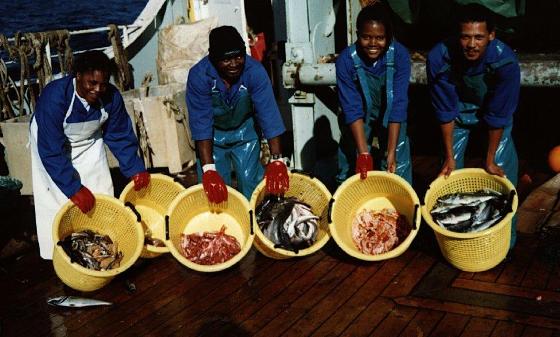
Foto: CDCF, IMR
Noen utdrag fra U Ds statsbudsjettproposisjon 2017:
Det nyopprettede utviklingsprogrammet,«Fisk for utvikling, (Ffu)» omfatter alle tiltak somNorge støtter innenfor fiskeri- og havbruksfeltet.Målet er å gjøre norsk kompetanse og ekspertisepå fiskeri- og havbruksområdet i større grad tilgjengeligfor utviklingsland. Innholdet i programmeter delt i tre hovedmoduler: Utdanning ogforskning (inklusive EAF Nansen-programmet),næringsutvikling (inklusive akvakultur) og forvaltningog regelverk (inklusive bekjempelse avfiskerikriminalitet). Elementer som inngår erblant annet å etablere regional, yrkesfaglig opplæringi tekniske disipliner på fiskerisektoren, envidereføring av EAF Nansen-programmet ved åbruke data fra programmet i opplæring av havforskerefra utviklingsland, bistå utvalgte land i åbygge opp kompetanse innen økosystembasertfiskeriforvaltning, og å styrke informasjons- og etterretningsutveksling om fiskerikriminalitet i,med og mellom risikoland. Småskala-næringsutviklingpå fiskerifeltet gjennomføres i samarbeidmed sivilt samfunnsorganisasjoner, mensnæringsutviklingstiltak i større skala vil kreve enannen finansieringsmodell og samarbeidspartnerefra privat sektor.