Ny doktorgrad ved NFH - Anja C. Winger, Institutt for akvatisk biologi
The survival of Gyrodactylus salaris in Northern Norway. The severe pathogen Gyrodactylus salaris survive and thrive on Arctic charr, a reservoir or natural host? Arctic charr (Salvelinus alpinus (L.)), an adequate host to Gyrodactylus salaris (Monogenea). A dissertation for the degree of Philosophiae Doctor, 26 May 2009.
Introduction
Arctic charr is a suitable host to Gyrodactylus salaris, which is highly pathogenic to Norwegian Atlantic salmon. It has driven most affected salmon populations to extinction. Because G. salaris is a non-pathogen to Arctic charr, its role as long term host to the parasite is highly important. In Troms County in northern Norway, two rivers are infected. These two rivers, Skibotnelva and Signaldalselva, are the northernmost G. salaris infected rivers in Norway and the natural salmon populations are regarded extinct or close to extinction due to the parasite. Skibotnelva has been treated twice with the plant poison rotenone. Both treatments failed, and an ongoing hypothesis is that the occurrence of Arctic charr is the main cause of this.
In order to examine the potential of Arctic charr as an adequate host to Gyrodactylus salaris, six key questions have been formulated.
- Is Arctic charr a long-term host to G. salaris in natural systems, and are the parasites found on Arctic charr in the rivers Skibotnelva and Signaldalselva, sustained on a whole-year basis (paper I)?
- Can G. salaris survive on allopatric anadromous Arctic charr parr throughout a long winter period with low temperatures (paper II)?
- Are newly-hatched Arctic charr fry susceptible to a G. salaris infection and is their role as a potential ‘lifeline' to the parasite in the spring prominent (paper II)?
- Can newly-hatched Arctic charr fry sustain a G. salaris population for a substantial time, making them important in the parasites` lifecycle (papers II, III and IV)?
- Can G. salaris cause additive mortality in Arctic charr fry (paper III)?
- To what extent does the gyrodactylids`facilityforcontinuous transmission between hostsinfluence the infrapopulation dynamics of G. salaris in Arctic charr fry (paper IV)?
The study
In the current study, the overall aim was to elucidate the role of Arctic charr as a long-term host to G. salaris. Both field and experimental studies have been undertaken. It was found that the abundance of G. salaris varies significantly throughout the year in both Skibotnelva and Signaldalselva, and is highest in the autumn and lowest in the spring. These seasonal fluctuations were repeated between years, and are mainly explained as temperature dependent constraints upon parasite reproduction.
Further, it was documented that Arctic charr in allopatry can sustain a G. salaris population during the five winter months, and also that newly hatched charr fry are highly susceptible to the parasite. The newly hatched charr fry experienced an additive parasite induced mortality. Furthermore, experimental studies indicated that parasite transmission occurs frequently within the charr fry population at all times during the colonization process. Hence, transmission probably is an important process in determining the infrapopulation structure by reducing the over-dispersion of G. salaris between hosts, and also may contribute to a prolonged period of growth of the parasite metapopulation.
In conclusion, this study clearly indicates that Arctic charr has to be valued as an important and adequate host to G. salaris which can sustain the parasite population within watercourses independent of the presence of infected salmon.
 asdf
asdf
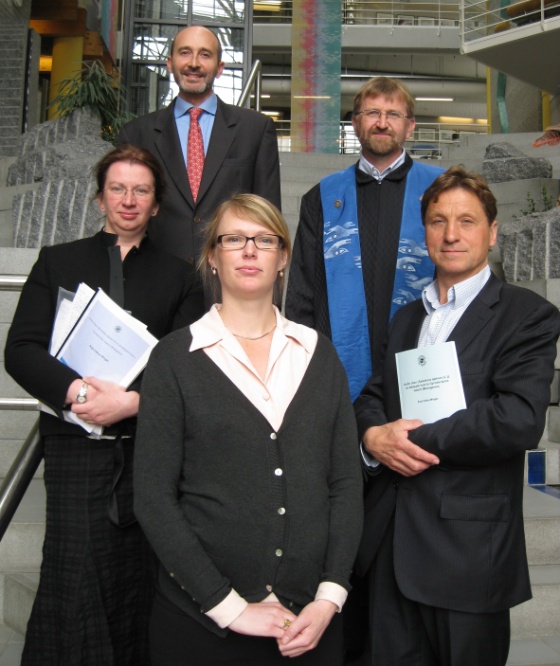
Anja Celine Winger and the evaluation committee, Dr. Joanne Cable, Cardiff University, UK, (1 opponent), Professor Kurt Buchmann, University of Copenhagen, Danmark (2 opponent) , Associate professor Stefano Peruzzi, NFH (Administrator) and chairman of the doctoral defence, prorektor Arne Eide. Fotograf: Henrik Romsaas
The candidate
Anja Celine Winger was born in Oslo in 1974. She graduated at University of Oslo in 2004 as Master of Science, specialazing in Parasittology. She is interested in general Parasitology, population dynamic and host/parasite interactions.