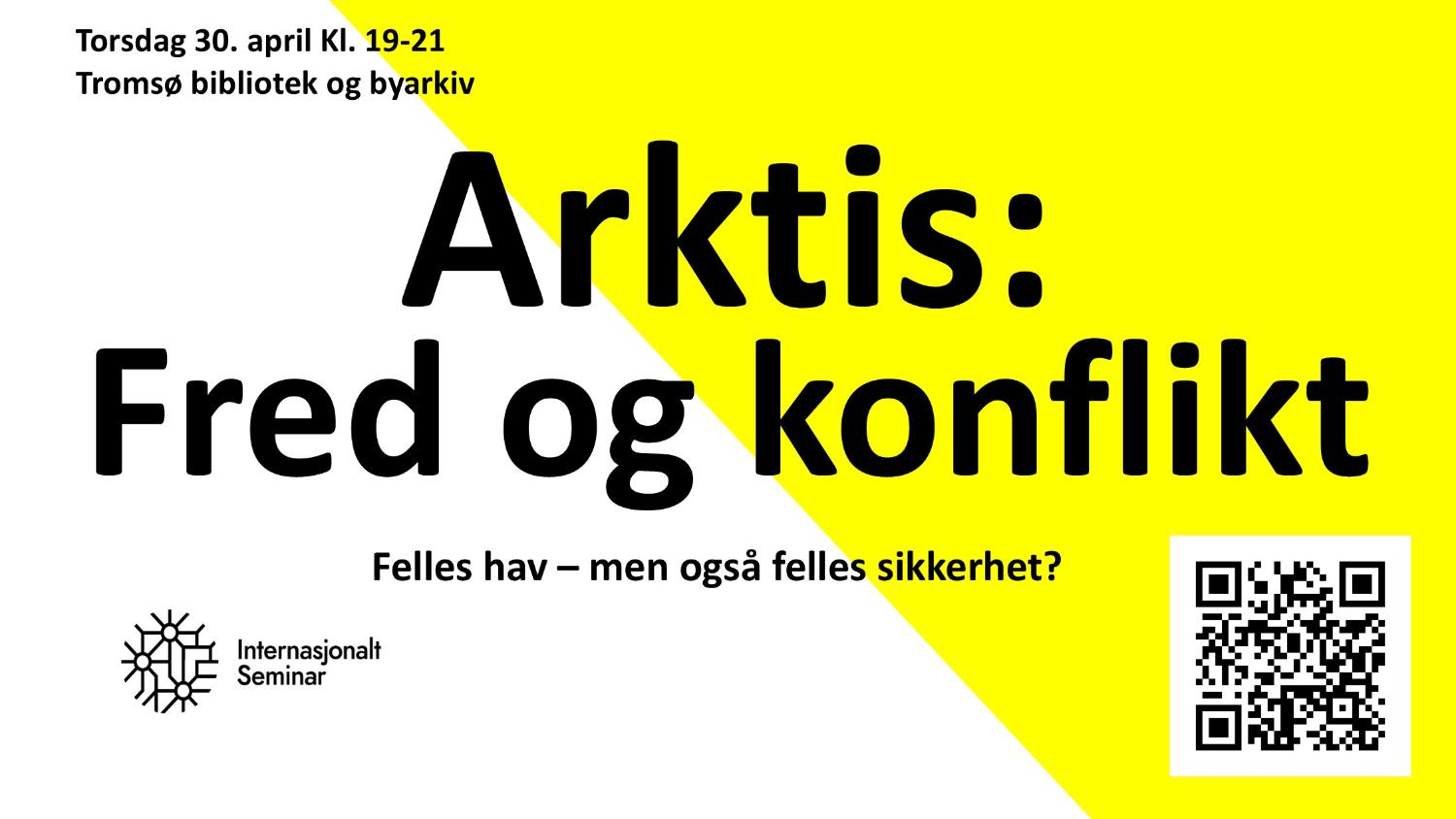
Debattmøte om miljø- og sikkerhetsutfordringer i Arktis / Debate Meeting on Environmental and Security Challenges in the Arctic
ENGLISH:
Hvordan vi kan styrke det internasjonale samarbeidet for å verne om natur og miljø i Arktis i en tid hvor fokus er rettet mot sikkerhet og geopolitikk? Dette er et av flere spørsmål som skal belyses på vårens siste møte i Internasjonalt Seminar.
NORSK:
How can we strengthen international cooperation to protect nature and the environment in the Arctic at a time when the focus is directed towards security and geopolitics? This is one of several questions that will be addressed at the final meeting of the International Seminar this spring.
Internasjonalt Seminar er et informasjons- og debattforum i Tromsø, som gjennom foredrag og paneldiskusjoner tar opp nord/sør-problematikk, miljø/klima, fattigdom/utvikling og krig/fred som sentrale tema.
Torsdag 30. april kl. 19:00-21:00, på Tromsø bibliotek og byarkiv, holdes det et debattmøte i Internasjonalt Seminar.
Tema for møtet:
I Arktis bor det om lag fire millioner mennesker, hvor rundt 10 prosent er urfolk, fordelt på åtte stater: Canada, Danmark (Grønland), Finland, Island, Norge (med Svalbard), Russland, Sverige og USA (Alaska).
Vi deler et felles hav med rike fiskeressurser. Klimaendringene merkes særlig godt i Arktis, og naturen er sårbar. Det finnes olje og etterspurte mineraler både i havet og på land.
Sju av statene er medlemmer av NATO. I tillegg har USA tilgang til militære baser i flere av de andre landene, med unntak av Russland. Grønland er gjenstand for økt politisk og militær interesse.
Russland og USA – verdens to atomvåpensupermakter – har en betydelig del av sine atomvåpen i Arktis, rettet mot hverandre. Havområdene i nord er et viktig område for militær aktivitet for begge stormaktene, gjennom etterretning, ubåter og andre militære fartøy.
Vi spør:
«Ingen er sikre før alle er sikre»
Dette heter det i Palmekommisjonens FN-rapport fra 1982, lagt frem under den kalde krigen. Den gang – som i dag – befant verden seg midt i et stort rustningskappløp.
Palmekommisjonens budskap var at militær avskrekking ikke er veien til fred, men at fred må bygge på felles sikkerhet for alle.
De foreslo blant annet nedrustningsforhandlinger, atomvåpenfrie soner, konfliktløsning gjennom diplomati og en styrket rolle for FN i fredsarbeidet.
Rapporten fikk stor betydning og påvirket mange ledende politikere, også i Norge. Hva kan vi lære av Palmekommisjonen i dag?
Paneldeltakere
Gunnar Rekvig – prosjektleder ved Senter for hav og Arktis, UiT – Norges arktiske universitet. Gjennom sitt arbeid ved Sasakawa Peace Foundation og en bred forskerkarriere har han særlig arbeidet med fred, tillitsbygging og utenriks- og sikkerhetspolitikk i Arktis, Norden og Øst-Asia.
Han har en Ph.d. fra Tokyo University of Foreign Studies, har vært Nansen-professor ved Universitetet i Akureyri, og er nestleder for Global Arctic-prosjektet ved Geneva Centre for Security Policy.
Rolf Rødven – daglig leder i AMAP (Arctic Monitoring and Assessment Programme), en arbeidsgruppe i Arktisk råd for overvåking av klima og miljø i Arktis.
Arktisk råd har i 30 år vært det viktigste internasjonale forumet for samarbeid om arktiske spørsmål, og har bidratt til fred og stabilitet i regionen. Til tross for en utfordrende geopolitisk situasjon fortsetter de åtte arktiske statene, sammen med seks urfolksorganisasjoner, arbeidet med å ivareta klima, miljø og bærekraftig utvikling.
Rasmus Gjedssø Bertelsen – professor i nordområdestudier ved UiT. Hans fagfelt omfatter arktisk internasjonal politikk, sikkerhet, vitenskapsdiplomati og geopolitisk strategi. Han har god kjennskap til Grønland, og har også vært Nansen-professor i arktiske studier ved Universitetet i Akureyri.
Møteleder
Kine Olsen, seniorrådgiver i FN-sambandet.
Etter innleggene blir det samtale, spørsmål og debatt der publikum kan delta.
Dette seminaret er støttet av Stiftelsen Fritt Ord og Fredsstiftelsen

Internasjonalt seminar har et program med 25-30 åpne møter i året.
Seminaret støttes av Tromsø kommune og koordineres av FN-sambandet Nord og Seksjon for internasjonalt samarbeid (SIS) ved UiT Norges arktiske universitet.
I tillegg støttes seminaret av Tromsøs humanitære organisasjoner, solidaritets- organisasjoner og studentorganisasjoner.
ENGLISH:
International Seminar is an information and debate forum in Tromsø, which addresses key topics such as North/South issues, environment/climate, poverty/development, and war/peace through lectures and panel discussions.
On Thursday, 30 April, from 19:00 to 21:00, a debate meeting will be held at Tromsø Library and City Archives as part of the International Seminar.
Topic for the meeting:
In the Arctic, approximately four million people live, of which around 10% are Indigenous peoples, spread across eight states: Canada, Denmark (Greenland), Finland, Iceland, Norway (including Svalbard), Russia, Sweden, and the United States (Alaska).
We share a common ocean with abundant fishery resources. Climate change is particularly noticeable in the Arctic, and the environment is fragile. There are oil and sought-after minerals both at sea and on land.
Seven of the states are members of NATO. Additionally, the United States has access to military bases in several of the other countries, except for Russia. Greenland is the subject of increased political and military interest.
Russia and the United States – the world’s two nuclear superpowers – have a significant portion of their nuclear weapons in the Arctic, aimed at each other. The northern seas are a critical area for military activity for both superpowers, involving intelligence, submarines, and other military vessels.
We ask:
"No one is safe until everyone is safe"
This is stated in the Palme Commission’s UN report from 1982, presented during the Cold War. At that time – as today – the world was in the midst of a major arms race.
The Palme Commission’s message was that military deterrence is not the path to peace, but that peace must be built on shared security for all. Among other things, they proposed disarmament negotiations, nuclear-weapon-free zones, conflict resolution through diplomacy, and a strengthened role for the UN in peace efforts.
The report had a significant impact and influenced many leading politicians, including in Norway. What can we learn from the Palme Commission today?
Panel Participants
Gunnar Rekvig – Project Manager at the Centre for the Ocean and the Arctic, UiT – The Arctic University of Norway. Through his work at the Sasakawa Peace Foundation and an extensive research career, he has focused on peace, trust-building, and foreign and security policy in the Arctic, the Nordic region, and East Asia.
He holds a PhD from Tokyo University of Foreign Studies, has been a Nansen Professor at the University of Akureyri, and is Deputy Leader of the Global Arctic Project at the Geneva Centre for Security Policy.
Rolf Rødven – Managing Director of AMAP (Arctic Monitoring and Assessment Programme), a working group under the Arctic Council for monitoring climate and the environment in the Arctic.
For 30 years, the Arctic Council has been the most important international forum for cooperation on Arctic issues and has contributed to peace and stability in the region. Despite a challenging geopolitical situation, the eight Arctic states, together with six Indigenous organisations, continue their work to safeguard the climate, environment, and sustainable development.
Rasmus Gjedssø Bertelsen – Professor of Arctic Studies at UiT. His field of expertise includes Arctic international politics, security, science diplomacy, and geopolitical strategy. He has extensive knowledge of Greenland and has also been a Nansen Professor in Arctic Studies at the University of Akureyri.
Moderator
Kine Olsen, Senior Adviser at the United Nations Association of Norway.
Following the presentations, there will be a discussion, questions, and debate where the audience can participate.
This seminar is supported by the Fritt Ord Foundation and the Peace Foundation.
International Seminar organises 25–30 open meetings annually. The seminar is supported by Tromsø Municipality and coordinated by the United Nations Association of Norway (North) and the Section for International Cooperation (SIS) at UiT The Arctic University of Norway.
In addition, the seminar is supported by Tromsø's humanitarian organisations, solidarity organisations, and student organisations.