The SAMFORSK Research Seminar Series, with the support of the UiT Aurora Outstanding Programme, is delighted to host a guest lecture by Dr. Philipp Schorch, Professor of Museum Anthropology at Ludwig-Maximilians-Universität in Munich, Germany.
The lecture is held at The Arctic University Museum of Norway Thursday March 12 at 13.30. Free entry!
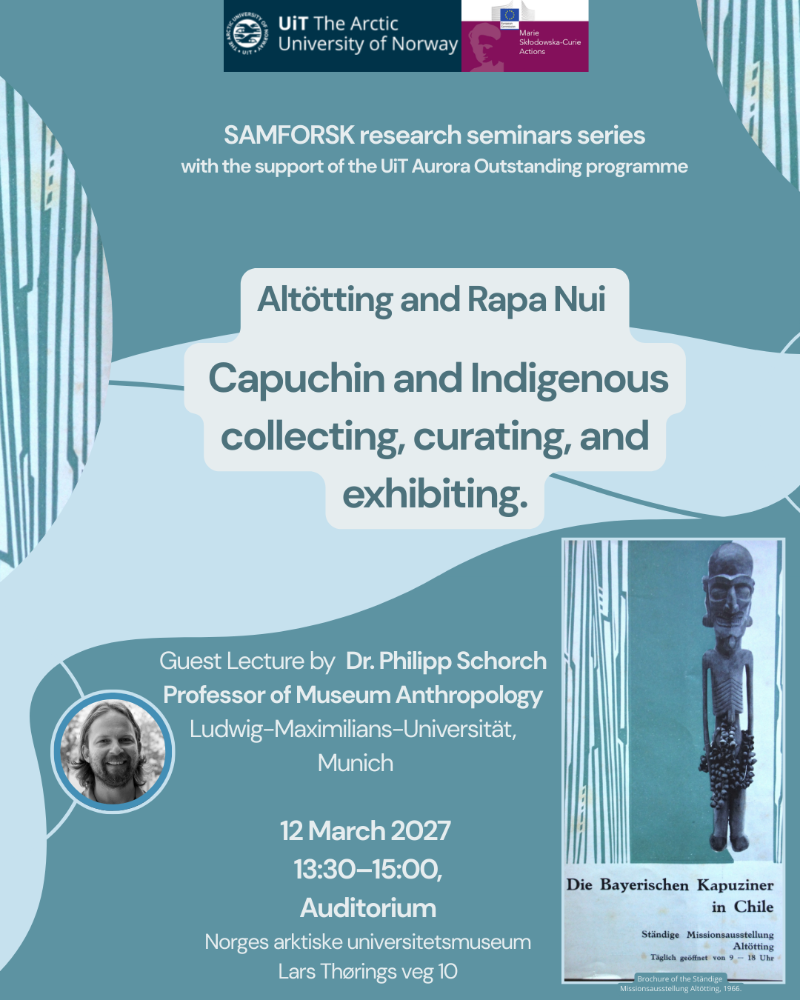
The Bavarian Capuchins who began arriving during the late nineteenth century in the southern region of Chile called Araucanía not only participated in the ongoing effort by Catholic priests to evangelise Mapuche and later Rapanui peoples. They also collected material things and ethnographic, linguistic, and other scientific data. Specimens and artefacts were sent to the monastery in Altötting, Bavaria, forming the basis of the Missionsmuseum (Mission Museum), which opened in 1910. In 1988, when the museum was closed and turned into the Stadtgalerie (City Gallery), the Mapuche collection and, in the 1990s, the Rapanui collection were donated to the Staatliches Museum für Völkerkunde, nowadays called Museum Fünf Kontinente (Museum Five Continents), in the state’s capital of Munich.
The Capuchin connection with Chile is important for our understanding of their activities on Rapa Nui between 1935 and 1992. In this context, Father Sebastian Englert became an emblematic figure: he lived for 33 years on the Island (1935–1968), working as a linguist and ethnologist, publishing important books on Rapanui history and language, and acting as one of the main informants of scientific figures such as Thor Heyerdahl, William Mulloy, and Thomas Barthel. He also began to promote the exhibition of Rapanui material that he and his Indigenous collaborators had collected. Around 1965, his collection was exhibited in a small room near the church, but in 1975 it was stored in a new building, the Museo de Isla de Pascua, which was later renamed Museo Antropológico Padre Sebastian Englert (MAPSE), in honour of his legacy.
This presentation follows a dual museological focus on Altötting and Rapa Nui, interrogating the modalities underpinning missionary and Indigenous collecting, curating and exhibiting, and examining the categories through which Rapanui things have been (re)conceptualised (for example, as natural history specimens, ethnological artefacts, craftworks, or pieces of art) in both localities. The presentation aims to answer the following questions concerning the dual Rapanui presence in Altötting and Rapa Nui: how have Indigenous histories and realities been presented in exhibitions in both settings? What similarities and differences can be detected in the associated construction of knowledge (historical, ethnographic, linguistic, and other kinds)? To which extent and in which forms can one discern Indigenous agency and authority involved in the shaping and representing of such knowledge?
Dr. Schorch leads the ERC-funded research project ‘Indigeneities in the 21st Century’ and is an Honorary Senior Research Associate at the Museum of Archaeology and Anthropology at the University of Cambridge, UK. His research spans museums, material culture, contemporary art, (post)colonial histories, and collaborations with Indigenous artists, curators, and scholars, with a particular focus on the Pacific and Europe.
Free entrance.
Når: 12.03.26 kl 13.30–15.00
Hvor:
Norges arktiske universitetsmuseum
Sted: Tromsø
Målgruppe: Ansatte, Studenter
Kontakt: Erika De Vivo
E-post: erika.devivo@uit.no