Obituary: A driving force in the north has left us
It is with great sadness that UiT The Arctic University of Norway received the news that former rector Professor Anne Husebekk passed away on 5 December after a period of illness.

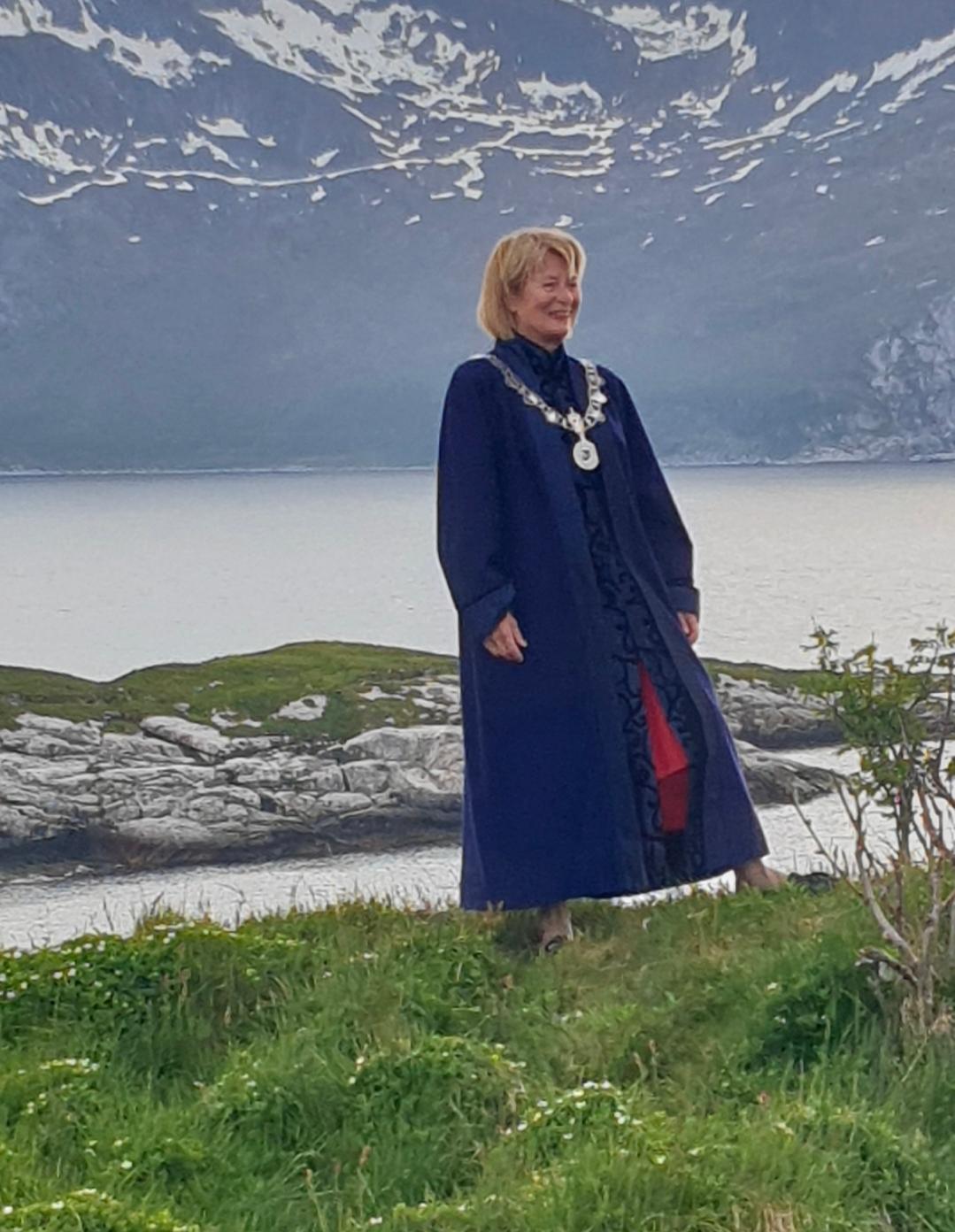
Fifty years ago, a young woman from the south of Norway who loved skiing and hiking came to Tromsø to study medicine. The combination of spectacular nature and exciting academic opportunities at the relatively new medical school was decisive for her choice. With great energy and devotion to the region, she became an important academic leader and society builder in the north for many years.
After completing her medical education in 1982, she worked as a junior doctor in Finnsnes and Volda, while also pursuing her research education. Husebekk earned a doctorate in immunology and transfusion medicine in 1989, became a specialist and later a professor in the same subject at UiT. Her scientific work is impressive in scope and has had a solid impact internationally. This led her to roles such as vice-president of the International Society of Blood Transfusion and guest researcher at prestigious research institutions. Husebekk promoted high standards and quality in research, but also that it should be put to into use. It was therefore only natural for her to contribute actively to innovation and business development when research results provided opportunities to develop new medical products.
When Husebekk took up the position as rector in 2013, the merger with the then University College of Finnmark had already been decided. However, the implementation and building of a common organisation and culture remained. With a steady course and a gentle tone, the Alta campus became a fully-fledged and integrated part of UiT during Husebekk's rectorate. Through this work, Anne became well acquainted with and very enthusiastic about the Alta community and the drive she saw there. The mergers with the university colleges in Narvik and Harstad were decided, implemented and completed under Anne Husebekk's leadership and with the same conviction that the region would be built through a strong academic institution. With the former Narvik University College of Engineering joining the UiT family, the university gained greater academic breadth and more engineering expertise.
Rector Husebekk served during a period when cooperation with Russian institutions was both possible and desirable. A series of delegation visits supported and strengthened Norwegian-Russian cooperation at the institutional level. Through these visits, Husebekk also became personally acquainted with several of the Russian university rectors. She was deeply affected when some of them strongly and wholeheartedly supported the Russian invasion of Ukraine.
Her international engagement was rooted in a genuine conviction that a university limited to the region in which it operates can never succeed in its social mission. This was particularly evident in her work in the network Universities of the Arctic, where she was deputy chair of the board, and in her efforts to convince philanthropists of the value of donating money to Arctic research. For her commitment to Arctic university cooperation, Professor Anne Husebekk was awarded Umeå University's Medal of Merit in 2022, an honorary award presented every three years for outstanding community service.
Anne Husebekk was deeply concerned about the free and independent role of research, its responsibility and integrity. This led her to a position in the International Science Council (ISC), the largest global association of research organisations, where, as vice-president, she was given responsibility for research integrity, accountability and independence. Husebekk viewed with concern how research was increasingly being mistrusted and misused in public debate, and how confidence in researchers and research was showing a downward trend. She emphasised that trust in research cannot be taken for granted, and that it is also the responsibility of researchers themselves to help maintain a high level of confidence in research-based knowledge.
She was able to weather the storm. For example, when it became clear to Husebekk that shared leadership at a university did not provide sufficient scope for academic leadership. She was able to change the model from shared to unified leadership, with the rector as the head of the university's overall operations. Under Norwegian law, this means that the rector is appointed by the board and not through election. This caused a storm, but Rector Husebekk was clear in her position: ‘A university should not be administered, it should be academically led, with the rector as the chief executive.’
After Husebekk stepped down as rector, she led the work to expand the capacity of medical education, served as acting director of the Centre for the Ocean and the Arctic, and continued to serve on numerous boards. Professor Husebekk was a member of His Majesty the King's Council of the Order of St. Olav and a recipient of the Order herself. This autumn, UiT organised a seminar in honour of Anne Husebekk in recognition of her academic leadership and role as a community builder.
This autumn, UiT organised a seminar in honour of Anne Husebekk in recognition of her academic leadership and role as a community builder. Prime Minister Jonas Gahr Støre said in his speech: ‘Therefore, as Prime Minister, I would like to be somwhat formal in my acknowledgement, thank and honour you, Professor, former Rector, who will soon be turning 70.’ Unfortunately, Anne Husebekk did not live to see her 70th birthday. Therefore, she did not get the opportunity to take the Prime Minister skiing on Tromsdalstinden, as she had promised. But as Prime MinisterJonas Gahr Støre concluded: ‘It is okay to hold on to dreams, and I am holding on to that dream.’