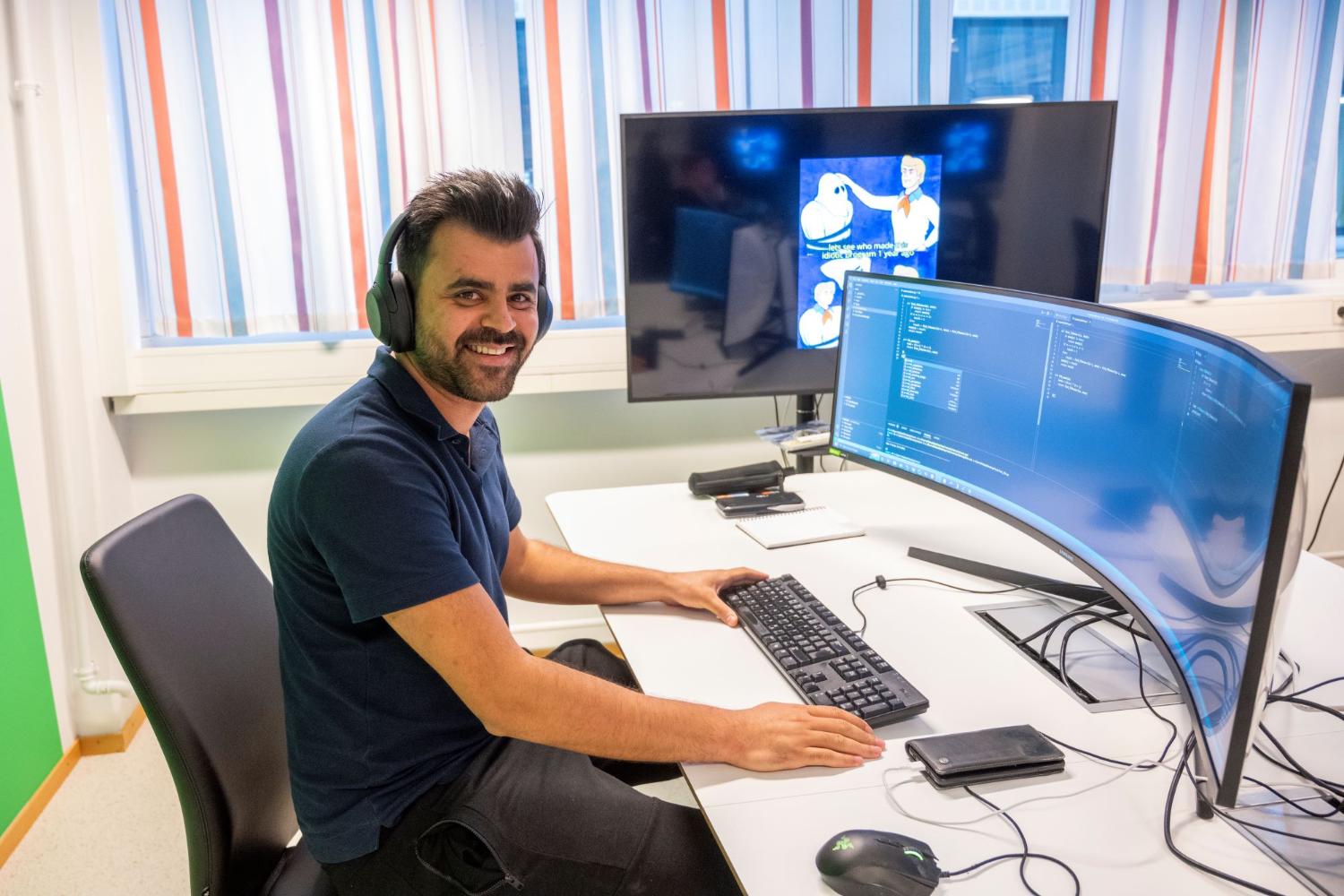
Drones, AI, and virtual worlds rely on computer technology. With a master's in Applied Computer Science, you can help address sustainability, healthcare, education, safety, and tech challenges. Make a difference by studying Master of Applied Computer Science in Narvik.
------------------------------------------
Droner, selvkjørende biler og kunstig intelligens ville ikke vært mulig uten programvare og datateknologi. Omstillinger i samfunnet og det grønne skiftet krever effektiv utvikling og teknologi for å kunne være bærekraftig. Bli med å gjør en forskjell gjennom master i Applied Computer Science i Narvik.
Her finner du norsk beskrivelse av Data/IT, sivilingeniør - master
Bachelor degree in Engineering programme in computer science or equivalent.
In addition, the following requirements must be met:
- A minimum of 25 ECTS in mathematics (equivalent to Matematikk 1, 2 og 3)
- 5 ECTS in statistics
- 7.5 ECTS in physics on a higher level is required.
The requirement for physics can be covered by 7.5 credits in physics, building physics, fluid mechanics, thermodynamics and/or mechanics of materials.
Admission capacity
20 places
Applicants from within the Nordic countries
If you don't have enough mathematics and/or physics to qualify for the master's degree, you can take one of these courses in the first semester at UiT in Narvik: TEK-2800 Mathematics 3 (5 ects) and/or TEK-2801 Physics 2 (5 ects)
The physics requirement of 7.5 ECTS is considered fulfilled for all university engineering educations that follow the NRT's (Norwegian Council for Technology) national framework plan, or by a combination of individual courses that together provide 7.5 ECTS in physics.
Applicants with a bachelor engineering degree from another field may take a qualifying one year course in Computer Science - Videreutdanning Datateknikk. (Narvik). The study language is Norwegian.
Applicants from outside the Nordic countries
You will find more information about international admission here.
-----------------------------------------------------
Søkere fra Norge/nordiske land:
Opptakskrav:
Bachelorgrad i ingeniørfag eller tilsvarende innen fagområdet datateknikk eller andre tilsvarende hovedfag.
Søkere med en bachelor ingeniørgrad fra et annet fagområde kan ta et kvalifiseringsår i datateknikk Videreutdanning Datateknikk. (Narvik).
I tillegg må følgende krav være oppfylt:
Det kreves minimum
- 25 studiepoeng i matematikk,tilsvarende Matematikk 1, 2 og 3
- 5 studiepoeng i statistikk
- 7,5 stp i fysikk på høyere nivå. Kravet til fysikk kan dekkes av 7,5 studiepoeng i fysikk, bygningsfysikk, fluidmekanikk, termodynamikk og/eller fasthetslære. Fysikk-kravet på 7.5 stp. anses oppfylt for alle bachelor ingeniør-/høgskoleingeniørutdanninger som følger NRTs nasjonale rammeplan, eller kombinasjon av enkeltemner med innhold som samlet gir 7.5 stp. fysikk.
Dersom du har for lite matematikk og/eller fysikk for å bli kvalifisert til master i teknologi, kan du ta ett av disse kursene i løpet av første semester ved UiT i Narvik: TEK-2800 Matematikk 3 (5 studiepoeng) og/eller TEK-2801 Fysikk 2 (5 studiepoeng)
Her finner du all informasjon knyttet til søking og opptak.
EU/EEA + Swiss applicants: 7143
Non-EU/EEA applicants: 9008
Program description
After completing this study, you will have the prerequisites to develop advanced computer games, virtual reality and create realistic simulations, such as collisions, rigid bodies, inverse kinematics and fluid mechanics. As a student you will benefit from the close bonds Narvik has to national and international research partners and our professional lab facilities. Throughout the studies you will build a strong and competitive fundament as a technical programmer and developer of advanced software and learning systems. The teaching activities are driven by active research groups within the fields of AI, geometric modeling and applied mathematics. This can serve as a basis for:
- Artificial intelligence (AI), machine learning and intelligent agents
- Geometric modeling, virtual reality, computer graphics and animations
- Object-oriented programming, meta- and GPU programming
- The development of large software systems, and massive multipurpose systems
After completing the diploma thesis on a selected topic, you are equipped with a comprehensive knowledge set in dealing with technical and managerial challenges, which makes you attractive to companies within many industries. Former students have generally found exciting opportunities as experts or leaders in the most technologically advanced companies or within academia.
Learning outcomes
After completion of the programme the candidate is possessing the following learning outcome.
Kunnskaper / knowledge:
- The candidate will have necessary basic knowledge as well as expertise knowledge to challenging jobs in research, industrial development and other areas. The knowledge is on a level such that the candidate can analyze problems and apply the knowledge in new areas.
- The candidate will have thorough knowledge of the different theories and methodologies of software development and especially computer programming, including advanced object oriented programming and meta-programming, based on knowledge of mathematics and technology applicable to both general-purpose programming and especially to technical applications on different platforms.
- The candidate will have special knowledge in the combined fields of geometric modelling and programming, geometry combined with artificial intelligence and programming, simulations/computations and programming, and geometry and computer graphics.
Ferdigheter / skills:
- The candidate will work independently with problems, by analyzing the problems and make plans for solving them.
- The candidate will be able to independently make large and/or complex computer programs that can run on different platforms.
- The candidate can carry out an independent research or development project within the field of computer science under supervision and in accordance with applicable norms for research ethics.
- The candidate can find, analyze and deal critically with various sources of information and use them in development and in argumentation.
- The candidate will be able to write a longer continuous report and present research clearly in written work and communicate knowledge in general orally and in writing.
Generell kompetanse / general competence:
- The candidate is influenced to maintain and develop curiosity and values such as openness, precision and the importance of separating between knowledge and opinions.
- The candidate can communicate about academic issues, analysis and conclusions in the field of computer science by using the relevant terminology to communicate with specialists and also with the general public.
- The candidate can contribute to new thinking and innovation processes in cooperation with experts from other fields.
Job prospectives
The Master's degree in Applied Computer Science qualifies for work internationally within a range of industries and diciplines, ranging from software engineering in general to development of domain-specific special software. Some examples include:
- Software development in general
- Virtual reality and simulators
- Graphical visualization systems
- Development of domain specific software solutions, e.g: oil and gas, CAD/CAM
- Computer games industry
- Machine learning and development of artificial intelligence systems
- Academic career within research and development
- Ansatt i Forsvaret
- Gründer
- IT-administrator
- Prosjektleder
- Spillprogrammerer
- Stipendiat
Degree Name
Master of Science in Applied Computer Science / 'Sivilingeniør'Access to further studies
UIT Campus Narvik has a ph.d. education within the field of Engineering Science and Technology. Students may be qualified for admission to this PhD programme click here to see these.
After successful completion of the degree programme, depending on satisfactory grades in the Master's and Bachelor's degree.
Related professions
Study plan
Language of instruction
The language of the study program is English. This will apply to teaching, syllabus material and examinations. There is also support for Norwegian language.
Teaching and assessment
The study is 2 years long, but with the possibility of an arranged course over 4 years for Norwegian/Nordic applicants.
Refresher course:
In Week 33 a two-days refresher course in linear algebra is offered. In this course, central concepts and methods from previous linear algebra courses will be repeated. Experiences from previous years are that students who participate in this refresher course benefit greatly from this in SMN6190 Linear Algebra II.
The master’s program is campus-based with physical presence and has a teaching model based on intensive weeks. The studies begin with a joint introductory meeting on UiT – campus Narvik during the first week of the semester.
The academic year is divided into four periods, and in each period students complete 15 ECTS credits. In a period where three courses of 5 ECTS each are taken, course 1 is taught in week 1, course 2 in week 2, and course 3 in week 3. This is followed by a self-study week during which students prioritize which course they want to work on. After that, the same three courses are taught again over three new weeks. Finally, the period ends with a self-study week followed by an exam week.
When the period is completed, a new period begins with 15 new ECTS credits. A period therefore lasts nine weeks. A 5-ECTS course is allocated 2 weeks, and 10-ECTS courses are allocated 4 weeks. The way teaching is carried out during an intensive week is determined by the lecturer, but normally each day consists of four hours of teaching and four hours of exercises.
The study program concludes with the master’s thesis, which is carried out during the entire final semester and is worth 30 ECTS credits.
The institute offers a wide range of project assignments within relevant topics, based on internal or external research activities. The project is individual, and the work should be performed at UiT - Campus Narvik. The resulting report/product will be presented in a plenary session on campus.
Destinations for studies abroad

Aleksander Pedersen
Head of Department of Computer Science and Computational Engineering