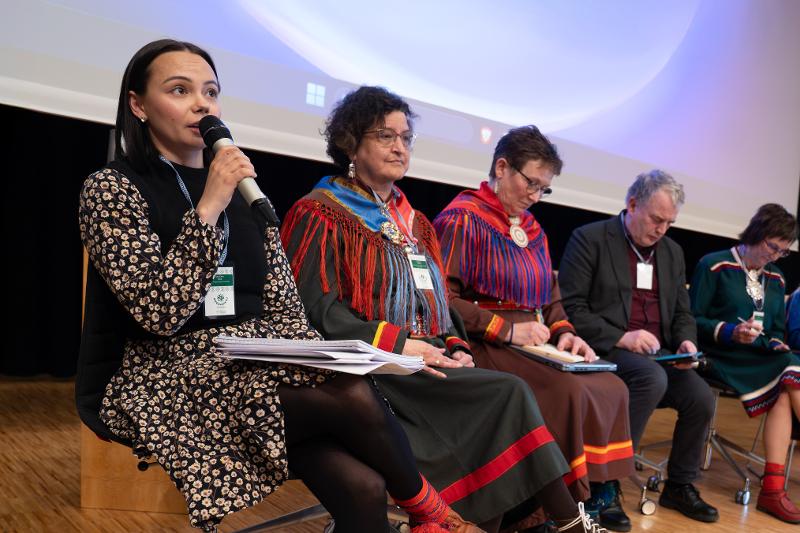
GIDA Sápmi participates in task group on Indigenous data governance
GBIF (Global Biodiversity Information Facility) Launches Indigenous Data Governance Task Group to Advance Equitable Biodiversity Practices
The Global Biodiversity Information Facility (GBIF) has announced the formation of the Indigenous Data Governance (IDGov) Task Group, a team of 12 experts—comprising eight members and four alternates—dedicated to protecting Indigenous rights and interests in biodiversity data and knowledge. This initiative aims to establish community norms that align with the CARE Principles for Indigenous Data Governance, ensuring equitable and ethical data practices across the GBIF network.

Leading the Way: Dr. Lydia J. Jennings
The task group is chaired by Dr. Lydia J. Jennings, a member of the Pascua Yaqui Tribe and Assistant Professor in Environmental Science at Dartmouth College, USA. Dr. Jennings emphasized the importance of recognizing Indigenous Peoples' inherent rights and knowledge in global biodiversity governance. "Indigenous Peoples have always been knowledge experts, data creators, and environmental stewards, but their expertise has often been marginalized or extracted. It is a privilege to collaborate with GBIF to strengthen practices that uphold Indigenous communities’ rights and expectations," said Jennings.
The CARE Principles: A Framework for Equity
The CARE Principles—Collective Benefit, Authority to Control, Responsibility, and Ethics—serve as a complement to the widely recognized FAIR Principles. They affirm the rights of Indigenous and local communities to act as self-determining custodians of open data, providing a framework for equitable biodiversity data practices throughout the data lifecycle.
Joe Miller, GBIF Executive Secretary, highlighted the organization's commitment to Indigenous leadership in biodiversity. "By amplifying Indigenous voices through the GBIF network, we hope to make FAIR data more fair and equitable for all while ensuring that the information we provide respects and empowers Indigenous communities," said Miller.
Key Objectives of the Task Group
The IDGov Task Group will focus on two primary objectives:
-
Assessing Familiarity with CARE Principles: Conducting a survey among GBIF node managers to evaluate their understanding of Indigenous data governance and sovereignty.
-
Pilot Projects with Indigenous Communities: Collaborating with three Indigenous communities—the Pueblo Kichwa de Sarayaku in Ecuador, Te Whakatōhea in New Zealand, and Te Pu Atiti'a in French Polynesia. These pilots will integrate Local Contexts' Traditional Knowledge and Biocultural Labels into GBIF’s data infrastructure, ensuring that Indigenous governance and protocols are respected.
Jane Anderson, co-founder of Local Contexts, emphasized the importance of provenance metadata in these pilots. "The addition of Traditional Knowledge and Biocultural Labels provides critical metadata that maintains the connection to community interests as the data moves across repositories," said Anderson.
A Path Toward CARE-Compliant Standards
The pilots are part of the GBIF Work Programme 2025 and aim to develop CARE-compliant data models, standards, and services. This effort will also explore ways to integrate Indigenous and local knowledge into the Darwin Core standard, a widely used framework for biodiversity data.
Looking Ahead: The 2026 Work Plan and Beyond
The task group will convene its first in-person meeting in October 2025 at the Living Data/Datos Vivos 2025 conference in Bogotá, Colombia. The group will play a prominent role in the event, with multiple presentations, symposia, workshops, and a keynote address by Dr. Jennings. During this meeting, the task group will begin drafting its 2026 work plan.
Engaging the Broader Community
Recognizing the widespread interest in Indigenous data governance, the task group is exploring the creation of an open, informal interest group. This virtual community would allow individuals across the GBIF network to engage with and contribute to the task group’s initiatives. Those interested can join the Indigenous data community email list to stay informed and participate.
With this initiative, GBIF is taking a significant step toward fostering equitable biodiversity data practices, ensuring that Indigenous voices are heard and respected in global biodiversity governance.
Read about it here
Published: 19.10.2025
Link to this page