Arctic Memoryscapes: Immersive Memory, Peace, and Collective Repair
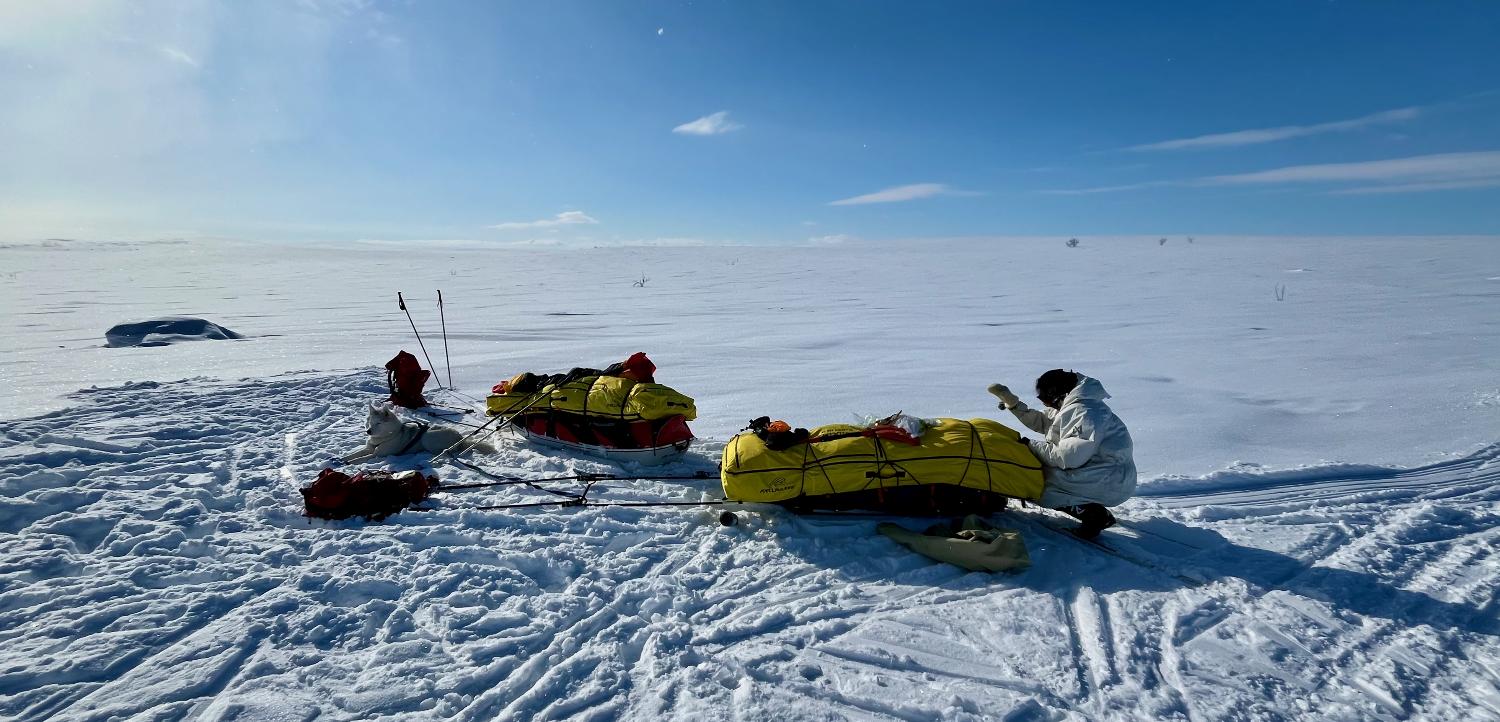 Finnmarksvidda fieldtrip - Ana Luisa Sánchez Laws and Kamilla Bergsnev
Arctic Memoryscapes investigates how collective memory, cultural heritage, and lived relationships to place shape possibilities for peace, justice, and coexistence in a rapidly changing Arctic.
The project understands peace not simply as the absence of violence or geopolitical tension, but as a form of human inventiveness: an ongoing practice of recognition, dialogue, care, imagination, repair, and learning. Peace must be made and remade. It depends on people’s capacity to confront difficult histories, live with disagreement, and create new ways of relating to one another, to their environments, and to the past.
Using artistic practice—including painting and ceramics—alongside extended reality (XR), immersive documentation, and AI-supported Gaussian Splatting, the project documents and explores changing Arctic memoryscapes: places, practices, and representations through which communities remember, contest, mourn, preserve, and reimagine shared histories.
The project is embedded in an Indigenous-methodology and activist-research framework, with community benefit, consent, cultural protocol, and locally grounded interpretation at its centre.
Why memoryscapes?
Collective memory is embedded in the cultural fabric of society. It shapes identities, narratives, relationships, and political claims. Memory can perpetuate conflict when it reinforces exclusionary stories of victimhood and perpetration, silences marginalized experiences, or is mobilized through unequal power relations.
But memory can also support processes of justice, reconciliation, and peacebuilding. Communities may choose to confront historical trauma, recover overlooked voices, commemorate loss, protect cultural heritage, and develop new forms of collective repair.
We use the term memoryscape to describe the living intersections of:
-
collective memory and history;
-
cultural heritage and place;
-
identity, belonging, and land;
-
trauma, justice, and reconciliation;
-
everyday practices of remembrance and care;
-
peace and conflict transformation.
Memoryscapes can include monuments, burial grounds, heritage sites, museums, landscapes, commemorative events, stories, artistic practices, and informal or everyday sites of memory. They are not passive containers of the past. They are active spaces in which people negotiate what has happened, what matters now, and what futures remain possible.
Peace as human inventiveness
The project is grounded in an understanding of peace as an active and creative human achievement.
Peace does not simply “happen,” nor can it be secured once and for all. It requires continual cultivation through individual and collective acts of restraint, care, mutual recognition, dialogue, accountability, and repair. It also requires imagination: the willingness to try new solutions, learn from failure, and refuse the assumption that conflict, exclusion, dispossession, or historical injury are inevitable.
In the Arctic, these questions are particularly urgent. Communities face interconnected pressures from colonial and extractive histories, climate change, environmental transformation, geopolitical insecurity, mobility, and contested cultural and territorial claims. Under such conditions, peace cannot be treated as a fixed model imposed from outside. It must be understood as a locally rooted, adaptive, and often experimental practice.
Memoryscapes may contribute to this work by helping communities:
-
articulate difficult or marginalized histories;
-
preserve and communicate relationships to land, ancestors, and heritage;
-
make visible experiences of loss, injustice, resilience, and care;
-
encounter diverse memories without requiring a single official narrative;
-
identify possibilities for dialogue, repair, and collective action.
The goal is not to manufacture consensus. Sustainable peace may instead depend on creating conditions in which distinct, unequal, and sometimes conflicting memories can be acknowledged and engaged with dignity.
Connection to EDGE
Arctic Memoryscapes extends EDGE’s research on emotion, exposure, and decision-making under uncertainty into the domain of trauma, reconciliation, heritage, and peacebuilding.
EDGE examines how immersive environments, portable physiology, and validated measures can help model and improve decision-making, de-escalation, and resilience in high-risk settings. Within the lab’s Trauma and Reconciliation sub-pillar, Arctic Memoryscapes explores how immersive and artistic memory work may support safe, dialogic, and community-led engagement with difficult pasts and uncertain futures.
The project asks how experiences of place, memory, emotional response, and social perspective-taking may shape:
-
perceptions of identity, belonging, and historical responsibility;
-
willingness to engage with complex or conflicting narratives;
-
empathy, recognition, and prosocial orientation;
-
resilience in the face of collective trauma and environmental uncertainty;
-
possibilities for de-escalation and locally grounded peacebuilding.
Where appropriate and ethically approved, the project may combine immersive documentation with qualitative, participatory, and validated psychological approaches to examine how people experience and interpret memoryscapes. These methods are not intended to reduce memory or peace to a set of metrics. Rather, they complement community interpretation by helping identify patterns in emotional experience, engagement, dialogue, and moments of perceived possibility.
Research questions
The project asks:
-
How is the interaction between collective memory, history, cultural heritage, and peacebuilding changing in the Arctic?
-
How do Arctic memoryscapes enable, constrain, or transform communities’ capacities to address historical trauma, competing identities, environmental change, and geopolitical uncertainty?
-
Which forms of memory-making may strengthen mutual recognition, justice, resilience, and peaceful coexistence—and which may reproduce exclusion, inequality, or conflict?
-
How do communities creatively adapt, contest, or invent memory practices in response to changing social, cultural, ecological, and political conditions?
-
How can the concept of memoryscape function as both an analytical framework and a participatory methodology for understanding these processes?
-
How can artistic and immersive media help communities document, communicate, and reflect on lived experiences of past, present, and future prospects for peace?
-
Can collaboratively interpreted immersive memoryscapes help identify “moments of possibility”—emotional, relational, or narrative tipping points where change becomes imaginable?
Methods
Arctic Memoryscapes combines field-based, artistic, immersive, and participatory methods.
Field research
The project documents memoryscapes through journeys, encounters, observations, conversations, and community collaboration in Arctic regions.
-
2024: A winter skiing journey through Finnmarksvidda initiated the project’s first field research and documentation.
-
2025: Participation in the Ocean II voyage aboard Statsraad Lehmkuhl supported the beginning of documentation work in Greenland and Canada.
- 2026: Journey through Finnmark under Preparedness Week
Artistic practice
Painting and ceramics are used not merely as illustrative outputs, but as methods of attention, interpretation, and dialogue. Artistic practice can register sensory, embodied, affective, and temporal dimensions of memory and landscape that may not be captured through conventional documentation alone.
Immersive documentation
The project uses XR (including virtual, augmented, and mixed reality) to create rich, multisensory representations of memoryscapes. AI-supported Gaussian Splatting may be used to document environments in immersive and spatially detailed formats.
These materials can support both research and communication: enabling communities and audiences outside the Arctic to encounter places, stories, concerns, and perspectives in forms that exceed text, maps, or conventional photography.
Analysis and co-interpretation
The project combines immersive documentation with:
-
multimodal discourse analysis of exhibitions, sites, narratives, and cultural representations;
-
participatory and community-guided interpretation;
-
Indigenous methodological perspectives;
-
attention to emotional and relational dimensions of memory;
-
where appropriate, safe and validated approaches to assessing prosocial, dialogic, or reflective outcomes.
Ethics, Indigenous methodologies, and data governance
The project recognizes that heritage, memory, land, and cultural knowledge are not neutral research materials. Some sites, stories, images, and practices may be sacred, sensitive, restricted, contested, or not appropriate for digitization or public circulation.
Accordingly, Arctic Memoryscapes is committed to:
-
meaningful community participation from project design through interpretation and dissemination;
-
free, prior, and informed consent;
-
respect for Indigenous sovereignty, cultural protocols, and local knowledge;
-
community authority over access, representation, interpretation, and circulation;
-
careful consideration of Indigenous data sovereignty and long-term digital stewardship;
-
the right of communities and participants to decline documentation, digitization, or public sharing;
-
trauma-informed, non-extractive, and dialogic research practice.
Immersive technologies can make memory more accessible and communicable, but they can also amplify risks of extraction, misrepresentation, or unwanted exposure. The project therefore treats technology as a tool whose value depends on its governance, its relationships, and its tangible value to communities.
Expected contribution
Arctic Memoryscapes aims to contribute in two connected ways.
For communities
The project seeks to support Indigenous, national-minority, and non-Indigenous Arctic communities in documenting how memory-making changes relationships:
-
between communities and their environments;
-
among Arctic communities;
-
between local communities and external actors;
-
between inherited histories and emerging futures.
Immersive memoryscapes may provide tools for communities to communicate concerns, strengths, challenges, and perspectives to audiences beyond the region in richer, multisensory, and community-guided forms.
For research and practice
The project will develop a body of documentation and methodological reflection on living, everyday processes of collective memory and heritage in the Arctic. It will also examine how immersive media, artistic practice, and participatory analysis can support trauma-informed and peace-oriented research without simplifying complex histories into a single narrative.
The project contributes to SDG 16: Peace, Justice and Strong Institutions by studying and strengthening bottom-up practices that may sustain peace, support justice, and help communities respond creatively to climate-related and geopolitical challenges in northern regions.
Key proposition
Memoryscapes do not automatically produce peace. They may deepen division as readily as they may foster recognition. Their peace potential lies in their capacity to make difficult histories visible, support community-led interpretation, preserve plurality, and open spaces in which relationships to land, heritage, trauma, and one another can be reimagined with justice and care.
Members:
Financial/grant information:
Funding for the first stage secured through The Arctic Six Chair in Cultural Memory (2024-2026).