Magnetic confinement fusion at UiT
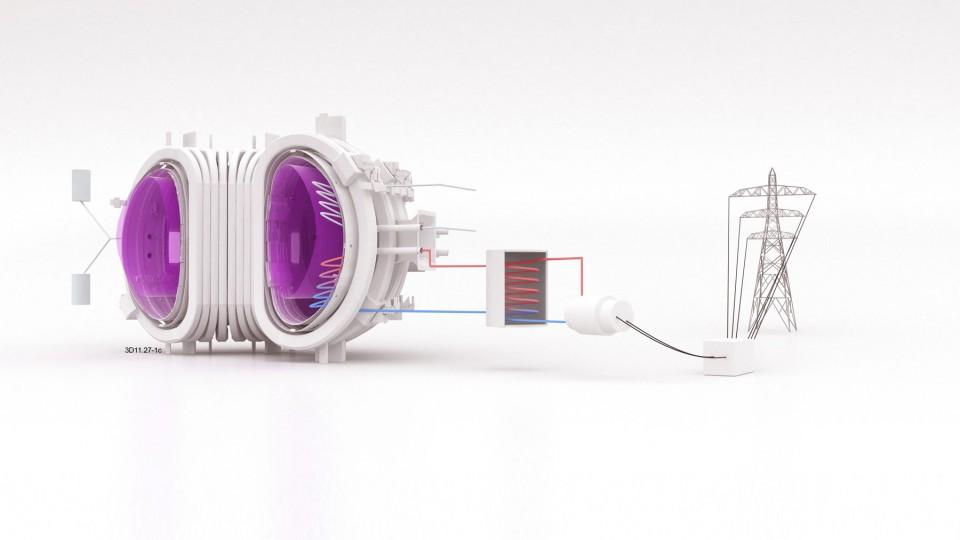 Simplified artistic impression of a tokamak connected to the grid. Copyright: UKAEA.
Magnetic confinement fusion is a cutting-edge approach to replicating the energy production process of stars here on Earth. Fusion occurs when light atomic nuclei, such as hydrogen isotopes, combine under extreme temperatures and pressures to form heavier nuclei, releasing vast amounts of energy. This process is clean, virtually limitless, and produces no long-lived radioactive waste.
To achieve fusion, the fuel must be heated to over 100 million degrees Celsius, creating a superheated plasma. Magnetic fields are used to confine and stabilize this plasma, preventing it from touching the reactor walls. Devices like tokamaks and stellarators are designed to create these magnetic "bottles," enabling the plasma to remain hot and dense enough for fusion to occur.
Magnetic confinement fusion holds the promise of revolutionizing energy production, offering a sustainable and environmentally friendly solution to meet the world's growing energy demands. Researchers worldwide are working to overcome the technical challenges and make fusion a reality for future generations.
The concept of controlled thermonuclear fusion involves using strong magnetic fields to confine a high-temperature plasma composed of electrons and the hydrogen isotopes deuterium and tritium. This method capitalizes on the fact that electrically charged particles can move freely along magnetic field lines while their motion across these field lines is significantly restricted. The most promising approach for achieving this confinement is through a toroidal geometry—a doughnut-shaped vessel—where a strong, helical magnetic field effectively insulates the electrically charged particles in the plasma from the surrounding walls. The leading method for magnetic confinement in potential fusion power plants is the tokamak. This design features an axisymmetric configuration, wherein the magnetic field is generated by combining a toroidal field, which directs particles the long path around the torus, with a poloidal field, which guides them along the shorter path.
The performance of a magnetically confined fusion plasma is ultimately determined by the boundary conditions at its surface. To manage direct plasma-wall interactions, modern confinement experiments utilize magnetic coils to create an X-point, where the poloidal magnetic field diminishes. The main plasma column is maintained within closed magnetic flux surfaces that lie inside the separatrix associated with the X-point. Outside the confined plasma is a thin layer known as the scrape-off layer, where particles and heat are lost primarily due to rapid motion along the magnetic field lines.