Målet med prosjektet er å identifisere lekkasjepunkter for avkapp fra bøting på trål og snurrevad og utvikle konkrete, bærekraftige løsninger som kan forhindre at avkapp havner i sjøen. Dette gjelder hele reisen til nettet, fra bøting til avfallshåndtering både på båt og i havn.
News archive
10.03.2026:
AVKAPP: Ansvarlig Kapping og Avfallshåndtering for Plastforsøplingsfri sjømatProduksjon
AVKAPP: Ansvarlig Kapping og Avfallshåndtering for Plastforsøplingsfri sjømatProduksjon
Målet med prosjektet er å identifisere lekkasjepunkter for avkapp fra bøting på trål og snurrevad og utvikle konkrete, bærekraftige løsninger som kan forhindre at avkapp havner i sjøen. Dette gjelder hele reisen til nettet, fra bøting til avfallshåndtering både på båt og i havn.
Det finnes allerede løsninger, men disse blir i altfor liten grad tatt i bruk. Resultatet ser vi tydelig på strendene i Norge, der avkapp utgjør en betydelig andel av søpla. I dette prosjektet skal vi derfor utvikle og teste løsninger som effektivt forhindrer at avkapp havner i sjøen. Vi benytter regenerative designprinsipper i innovasjonsprosessen for å oppnå dyp innsikt i de fysiske og prosessuelle elementene som må iverksettes for å fungere i praksis gjennom hele reisen til nettet.
Dialog med brukere og aktører langs hele reisen er en nøkkelfaktor. Dette sikrer at løsningene er gjennomførbare i praksis og ikke skaper nye bærekraftutfordringer. AVKAPP vil levere konkrete resultater i form av rapport, videodokumentasjon, og infografikk på både norsk og engelsk.
Testing og brukerdialog vil gjennomføres på følgende arenaer:
UiTs trålforskningstokt med F/F Helmer Hansen, SINTEF Ocean sitt forskningstokt på snurrevad I samarbeid med eksperter på redskapsteknologi fra både NFH og SINTEF.
Norges Fiskarlag vil bruke sitt nettverk av fiskere for å sikre involvering og praktisk relevans.
Prosjektet er finansiert av Handelens Miljøfond
Følge prosjektet på vår nettside: https://uit.no/project/avkapp
Responsible Cutting and Waste Management for Plastic-Free Seafood Production
The goal of the project is to identify leakage points for cut-offs from mending of trawl and seine nets, and to develop concrete, sustainable solutions to prevent cut-offs from ending up in the sea. This applies to the entire fishing net value chain, from net mending to waste management, both onboard the vessels and in the harbours.
Although simple solutions already exist, they are not widely adopted. The result is evident on Norwegian beaches, where cut-offs constitute a significant proportion of the litter. Therefore, in this project, we will develop and test solutions that effectively prevent cut-offs from ending up in the sea. We will apply regenerative design principles in the innovation process to gain deep insights into the physical and procedural elements that need to be implemented to function in practice throughout the value chain. Dialogue with users and stakeholders who are crucial for implementing the solutions across the entire value chain is central. This ensures solutions that are practical to implement and do not create new sustainability challenges. AVKAPP will deliver solutions in the form of reports, video documentation, and infographics in both Norwegian and English.
Testing and user dialogue will take place during:
UiT's trawl research expedition with the research vessel F/F Helmer Hansen, SINTEF Ocean's research expedition on Danish seine nets, and In collaboration with experts in gear technology from both NFH and SINTEF.
The Norwegian Fishermen's Association will use its network of fishers to ensure involvement and practical relevance.
The project is financed by the Norwegian Retailers’ Environmental Fund.
Follow the project on our web-page: https://uit.no/project/avkapp
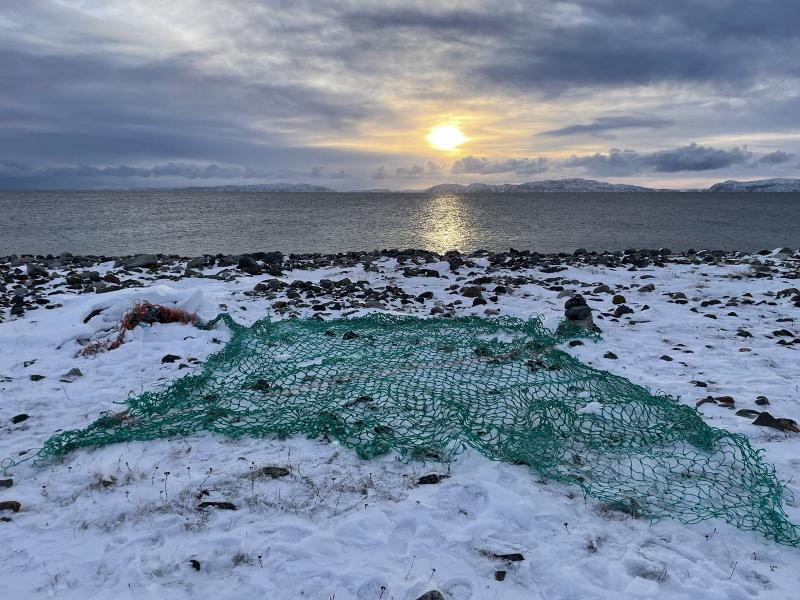
Larger pieces of nets represents a risk to coastal biodiversity (Photo: J. Falk-Andersson).
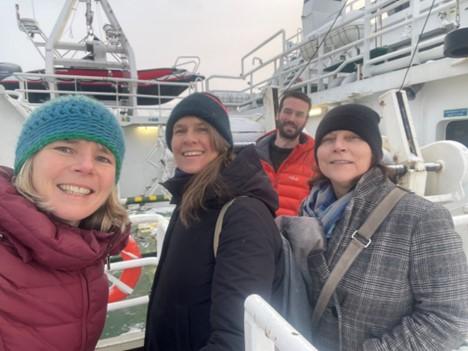
Jesse Brinkhof (in the back) holds key expertise on fishing gear technology. Here from the research vessel FF Helmer Hansen. From the left: Falk-Andersson, expert on marine litter, Birgitta Ralston, expert on regenerative design practices, and Anne Katrine Normann, expert on waste management in harbours (Photo: Falk-Andersson).
Lenke til nyhet
01.05.2025:
MECCAM: New EU project on climate mitigation and adaptation in fisheries started 01.05.2025
The 1st of May marked the official launch of MeCCAM (Measures for Climate Change Adaptation and Mitigation in European Fisheries). MeCCAM is a four-year project aimed at equipping the European fisheries sector with innovative, science-based solutions to adapt and mitigate climate change. The project is coordinated by Sjókovin in the Faroe Islands and brings together 16 partners from 9 European countries. The project is funded by Europe Horizon with a total of budget of EUR 4.5 million.
Over the next four years, MeCCAM partners will develop, implement, and recommend mitigation and adaptation solutions to reduce the environmental impact and increase the resilience and sustainability of the European fisheries sector. The solutions are designed to respond to a broad range of challenges faced across Europe - from the Northeast Atlantic to the Mediterranean – covering large to small scale fisheries.
27.03.2025:
Effective litter monitoring - a three-step process involving decision makers
Monitoring of levels and sources of macrolitter is important for decision makers to prevent and reduce the amount of this pollution in the environment.
11.03.2025:
Marine heatwaves in the polar regions
New scientific review on the characteristics and impacts of marine heatwaves in Arctic regions
09.02.2023:
New Horizon Europe project on how to implement the Green Deal in the marine: PERMAGOV
What is the best way to implement the EU's Green Deal in the marine? The new Horizon Europe project PERMAGOV will investigate this